Provenance
Where coffee wood dog chews come from: the tree and the farm
Auf Deutsch: Woher Kaffeeholz für Hundekausnacks kommt: der Baum und der Hof
Almost every supplier of this product says the same sentence: made from old coffee trees, a by-product, sustainable. It is a sentence that costs nothing to write and tells a buyer nothing they can check. This page sets out the part that is checkable — who decides when a coffee tree comes down, how much wood that releases in a year, and why stems from young trees are thrown away. Those three facts explain most of what a buyer actually wants to know: whether the supply will still be there next season, and whether the sustainability line survives contact with a compliance officer.
The short answer
The stems come out of the ground because the farmer is replanting, not because anyone wants chews. WINVN INT takes stems from trees 20 years and older, rejects the young ones and cuts them to billets in the field. The supply is real, it is slow, and it is finite in any given season.
1. Who decides when the tree comes down
A coffee tree is a farm's income. Nobody removes one that is still yielding well, and no chew order is large enough to change that arithmetic. The decision belongs entirely to the farmer, and it is made on one basis: the tree has aged past the point where its cherry yield justifies the space, the fertiliser and the labour it consumes.
When it does, the farmer takes the tree out and puts a young one in its place. The stems are then a problem to be cleared rather than a product to be sold — which is where WINVN INT comes in, after the decision, not before it.
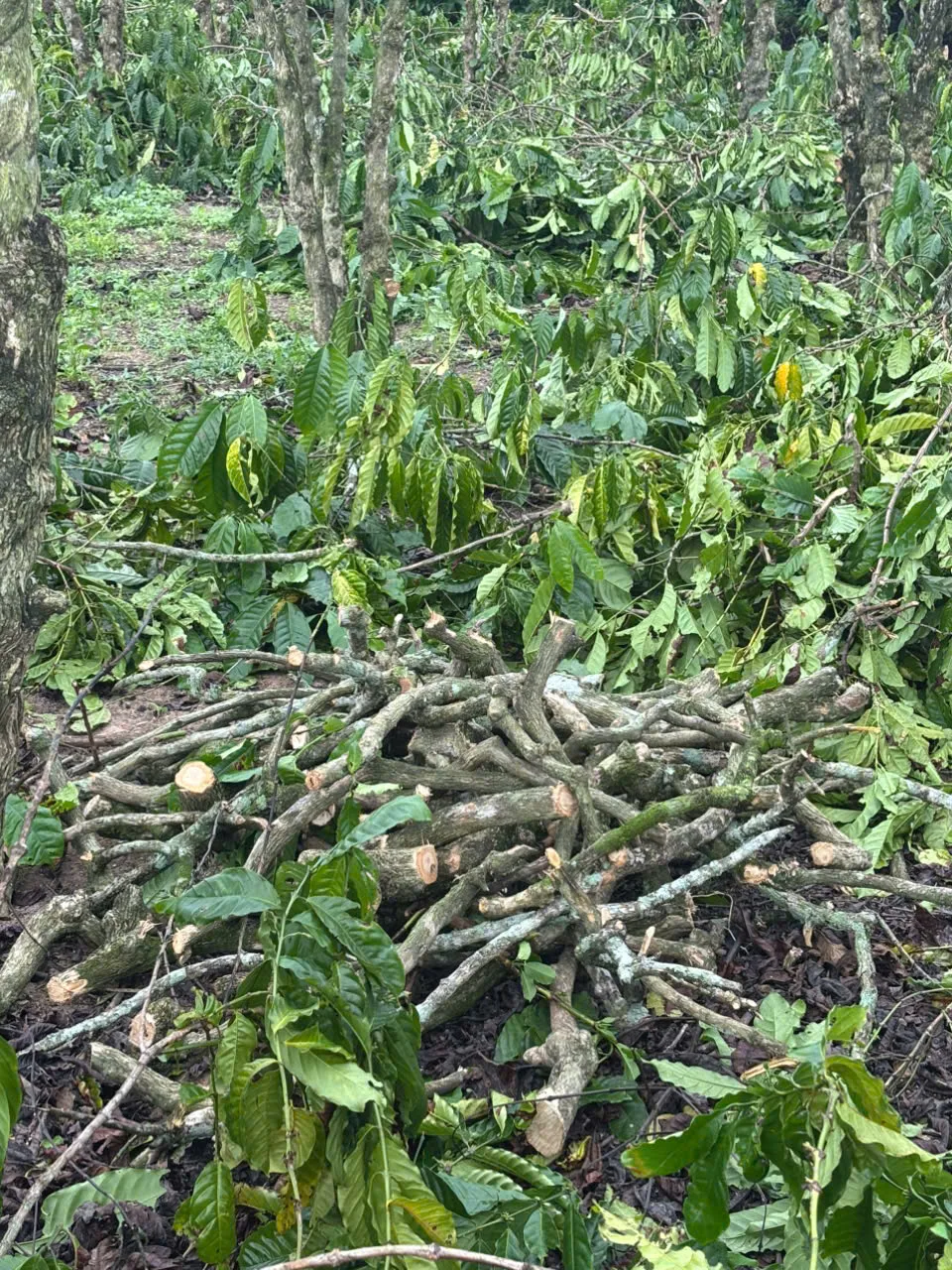
Whether this counts as a forest product in law is a separate question with a separate answer, and it is the one an EU buyer has to satisfy their own compliance team on. It is worked through on the EUDR page.
2. The arithmetic of a coffee farm
This is the section that explains why supply behaves the way it does.
| Figure | Typical | What follows from it |
|---|---|---|
| Time from replanting to first crop | ≈ 3 years | Nobody replants a whole plot at once; the farm would have no income for three years. |
| Time to full production | ≈ 5 years | Replanting is spread deliberately across seasons, which spreads the wood too. |
Put together, those figures describe a supply that is collected rather than harvested. Buying volume means visiting many plots across a season and taking what each one releases, which is slower and more expensive per tonne than cutting a stand, and it is the reason a serious quantity of this material cannot be assembled in a hurry at any price.
It also sets a practical test a buyer can apply to any supplier, including this one. Ask how the material is accumulated and how far ahead stock is committed. A supplier working from real plots will describe a collection season and a holding period. A supplier who answers that volume is unlimited and available immediately is either selling someone else's stock or describing a different material.
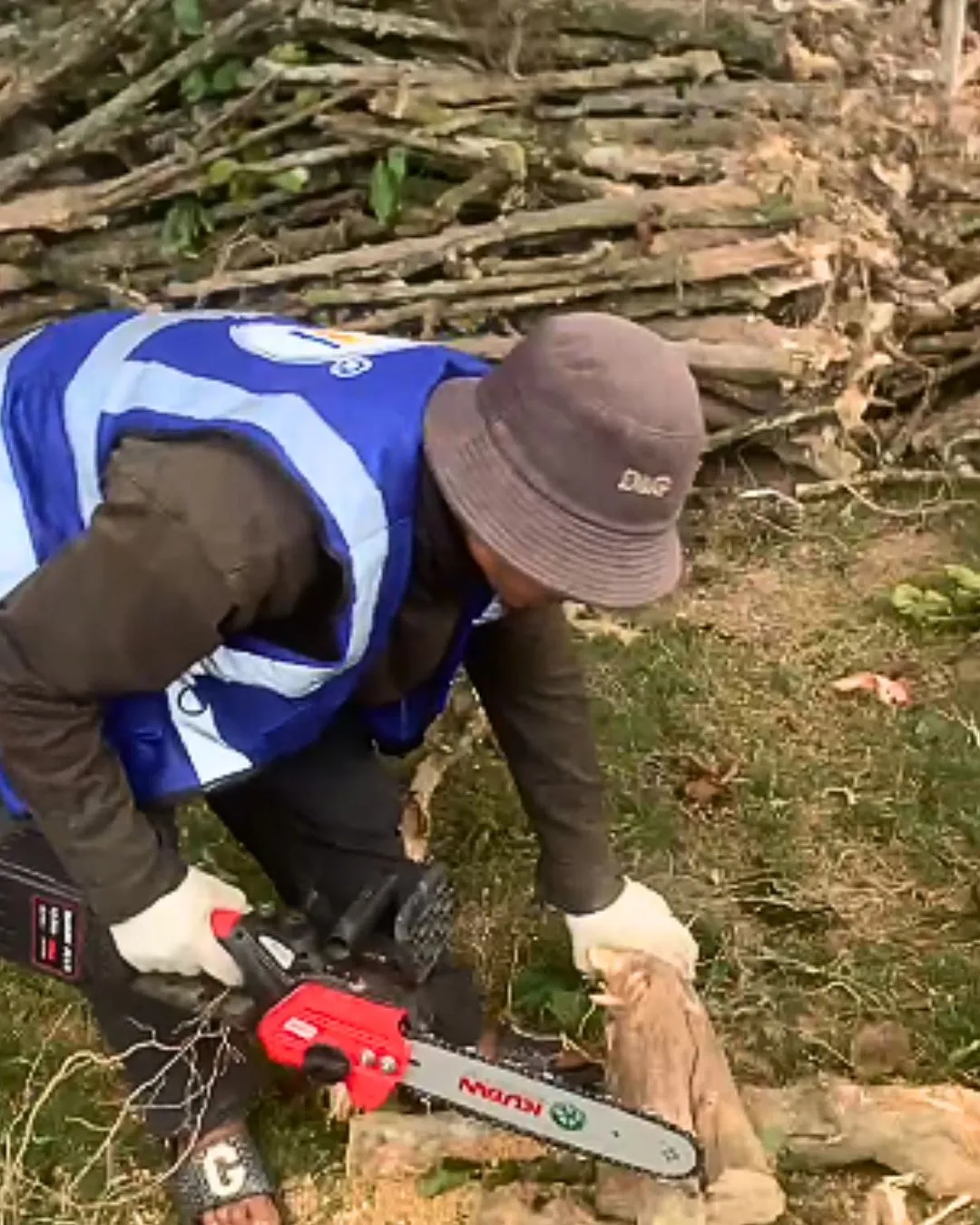
3. Why stems from young trees are rejected
Not all coffee wood is usable, and the age of the tree it came from is the single biggest predictor. WINVN INT does not take stems from trees under 20 years old, for two reasons that all end up in the same place — a complaint from the buyer's customer several months later.
- The wood is not hard enough. Density builds with age. A stem from a young tree gives a chew that goes down far faster than the same size cut from an old one, and the end user reads that as a product that does not last.
- Young stems attract borers. Softer wood is more prone to insect damage, and damage that is invisible at packing is very visible after five weeks in a container.
Age is not a claim a buyer has to take on trust, either. A coffee stem lays down one growth ring a year, so the rings on a cut face are a rough count of the tree's life. It is not laboratory evidence, but it is more than most suppliers will let you check with your own eyes on a sample.
4. What the wood would otherwise have been
The honest baseline for anything sold as a by-product is what happened to it before there was a buyer. For coffee stems on most Central Highlands farms, the answer is firewood, or clearing and burning at the edge of the plot.
That is the whole of the environmental claim WINVN INT is prepared to put in writing, and it is deliberately narrow: this is material that already exists, that had an established low-value use, and that now returns a second payment to the farmer from a tree that has stopped paying. Everything past that point — carbon figures, offset arithmetic, net-zero language — WINVN INT has not measured and therefore does not publish.
- No FSC claim. FSC certifies forest management. Coffee is an agricultural crop on registered farmland, so the scheme does not apply to these plots, and a supplier waving an FSC logo over coffee wood is worth a second look.
- No carbon or offset claim. WINVN INT publishes no CO2 figure for this product and makes no offset claim.
- No "zero waste" claim.
- The claims on your pack are yours. Environmental wording on pet products sold in the EU is being tightened by Directive (EU) 2024/825 from 27 September 2026, and the substantiation has to sit with whoever prints the words.
Buyers who need a sustainability story that survives a compliance review generally prefer this shape of answer to a longer one. A narrow claim you can evidence beats a broad claim you cannot.
5. From standing stem to sorted billet
Between the plot and the workshop there is a short sequence that decides how much of the material survives.
- Cut to billet in the plot. Stems are cut to billets where they fell. Forks are trimmed off at this stage, because carrying them wastes truck space that has to be paid for either way.
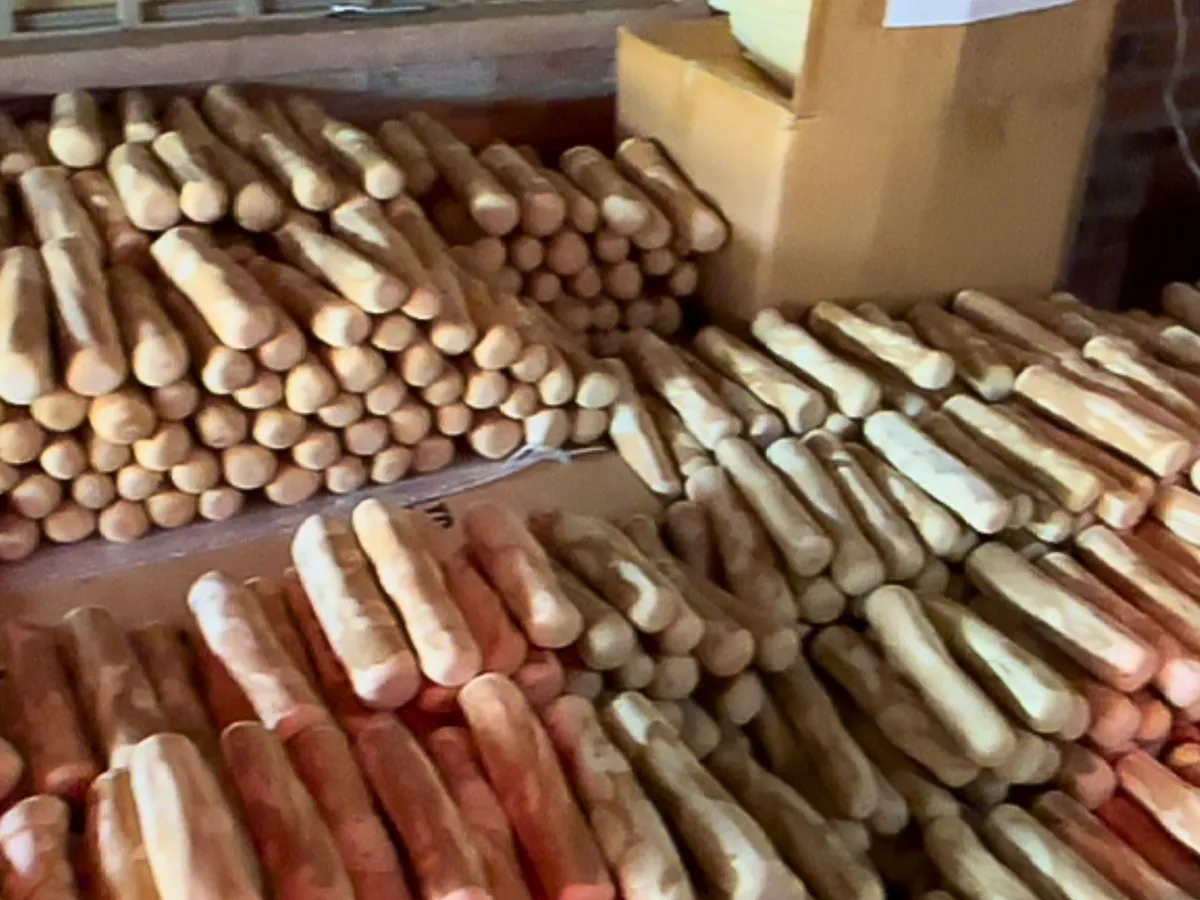
- Sorted by diameter on arrival. Billets are separated into size classes before storage, not after. Thin material and thick material dry at different rates, so they are stacked apart; mixing them is how a batch ends up with some pieces over-dry and cracked and others still wet in the core.
- Stacked in ventilated shade. Out of direct sun, under cover, with air able to reach the stack. Sun on a stack of green billets is the fastest way to split them, which is the reason this step looks unhurried and expensive and is neither.
Machining happens against orders, not into stock — the surface finish of a piece degrades in storage far faster than the billet it was cut from does.
6. Between the farm and the factory
The single most important thing about this material is also the least visible: after it is cut and sorted, it sits. Wood that has not come down to a stable moisture content in its own time will do it later, in a sealed steel box, on somebody else's ocean freight.
Two consequences follow, and both matter commercially.
- Lead time and supply are different clocks. The underlying supply moves at the speed of replanting. A buyer planning a Q4 range is negotiating against stock that already exists; a buyer asking for a step change in annual volume is negotiating against next year's collection.
- Stock is what a supplier can honestly commit against. Anyone quoting large volumes against a season that has not happened is passing you a risk rather than a price.
WINVN INT publishes the outcome of the drying and conditioning work rather than its recipe — the temperatures, durations and stage order are treated as proprietary and are not on this site. What is available to a buyer is the result: moisture measured below 14% at the factory. The mechanics of why that number decides whether a shipment arrives clean are on the moisture and mold page.
7. Why the region is part of the specification
Vietnam's Robusta belt sits in the Central Highlands — Dak Lak and Gia Lai. Two features of it are relevant to a chew rather than to a cup of coffee.
- Basalt soil and plantation age. These are established coffee provinces on their second and third replanting cycles, which is what makes a steady flow of genuinely old stems available at all. A young coffee region does not have this material to sell yet.
- A defined dry season. Ambient conditions do a large part of the work that a kiln would otherwise have to do fast and badly. Wood brought down in air over months behaves differently in a container from wood pushed down in hours with heat.
WINVN INT identifies the region and names the provinces. Individual farms and plot locations are not published, for the ordinary reason that a supply relationship built over years is not something to hand to a competitor with a screenshot.
8. What this means for your order
Provenance is only worth reading if it changes a decision. Four ways it should.
- Place seasonal orders early. The material is committed ahead.
- Ask what stock backs the quote. It is a fair question and a revealing one.
- Treat a size mix as a supply question, not just a sales question. If your market skews to XL and XXL, say so early rather than at PO. The sizing page has the size arithmetic.
- Write the sustainability line you can defend. By-product of coffee farming, alternative use was firewood, no forest cleared. Not carbon neutral, not FSC, not zero waste. The narrow version is the one that survives.
Questions buyers ask
Are trees cut down to make coffee wood dog chews?
No. The stems are taken out by the farmer as part of replanting a coffee plot, at the end of the tree's producing life, and WINVN INT buys them after that decision has already been made. Nobody fells a coffee tree that is still yielding cherries, because the tree is the farm's income and a replacement takes about three years to give a first crop and five to reach full production. The chew is made from material that already exists, on a schedule set by farm economics rather than by chew demand.
How old are the coffee trees the wood comes from?
20 years and older, at the point where yield has dropped far enough that the farmer replants. Age is visible in the piece itself, because a coffee stem lays down one growth ring a year.
Does WINVN INT have an FSC certificate for coffee wood?
No, and it is worth understanding why rather than treating the absence as a gap. FSC certifies the management of forests. Coffee is a perennial agricultural crop grown on registered farmland, not a forest, so the plantations this material comes from are outside the scope of the scheme.
Why is the supply of coffee wood limited?
Because it is released by replanting, not by harvesting. The material therefore arrives in small quantities from many farms across a season rather than in bulk from one place. A supplier who tells you volume is unlimited and immediate is describing something other than this supply chain.
What would happen to the wood if it were not made into chews?
On most farms it is burned as firewood or cleared from the plot. That is the honest baseline, and it is the one claim in this area WINVN INT is willing to put in writing: the material is a by-product of coffee farming that has an established alternative use, and buying it gives the farmer a second payment from a tree that has stopped paying. WINVN INT does not publish carbon figures, offset claims or net-zero statements, because it has not measured them.
Where in Vietnam does the coffee wood come from?
The Central Highlands provinces of Dak Lak and Gia Lai. This is Vietnam's Robusta belt: basalt soil, a defined dry season, and plantations old enough to be on their second or third replanting cycle. The dry season matters for a practical reason as much as an agricultural one, because the material has to come down to a stable moisture content in ambient air rather than in a kiln. Exact farm locations are not published.
Ask what stock the quote is drawn against
Tell WINVN INT the sizes and quantities you are working towards and our sales team will reply by email. 3 free samples per customer. You cover the shipping cost, which can be credited against your first qualifying production order. Our sales team confirms the details.
Ask about current stock and lead time