Compare
Coffee wood vs olive wood: what actually differs
Auf Deutsch: Kaffeeholz-Kausnacks im Großhandel: was ein Einkäufer vom Hersteller verlangen sollte — die deutschsprachige Übersicht für Großhändler, keine Übersetzung dieser Seite.
These two sit next to each other on the same shelf and get described in almost the same words. The real differences are not the ones the packaging talks about. They are the oil, the import route, and which of the two has published material data.
This comparison is written by a coffee wood manufacturer, so read section six first — that is where olive wood wins, and it wins outright.
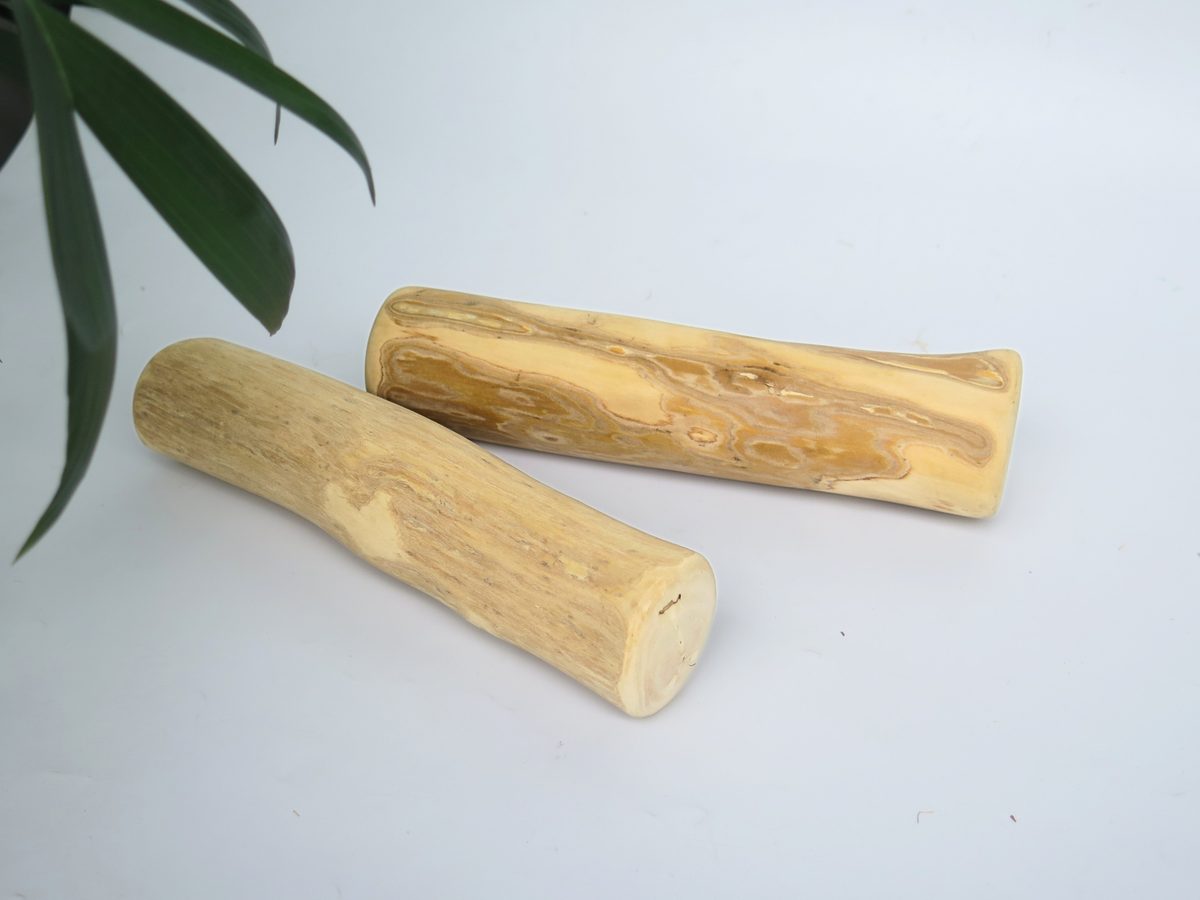
What each one is
Coffee wood is cut from the trunk of coffee trees taken out at the end of their productive life. WINVN INT's material is one plant material: no glue, no coating, no colouring, and nothing applied to the surface.
Olive wood is usually cut from prunings — olive groves are pruned every year or every second year, and the olive branches are a by-product. Some supply chains work differently: at least one Tunisian olive wood exporter describes its raw material as aged, fruitless trees taken out of production, which is the same logic as coffee wood rather than a pruning by-product.
The difference most buyers miss: the oil
Most olive wood chews are dipped or infused with olive oil. That is not marketing chatter — it is in the customs record. HMRC Advance Tariff Ruling 600010484, valid from 31 May 2024, describes the goods as olive branches sanded to remove sharp edges and then “dipped in olive oil”. Retail listings for several olive wood brands say the same on the pack.
So the honest comparison is not wood against wood. It is one plant material with nothing added against wood plus a food oil. Neither is wrong. But if your label says single-ingredient, or if you have to answer an allergen question from a retail buyer, that is a difference you need to know before you write the copy.
Hardness and density: olive wood has the numbers, coffee wood does not
This is the section a supplier is supposed to skip. Here it is anyway.
| Figure | Olive wood | Coffee wood |
|---|---|---|
| Dried density | about 980 kg/m³ | no comparable published figure |
| Janka hardness | about 2,710 lbf | none published |
| Listed in standard timber databases | Yes, as Olea europaea | No |
Olive wood figures from the Wood Database entry for Olea europaea.
Coffee is not a commercial timber species. It is an agricultural crop, and the wood is a recovered by-product, so it has never been through the testing that puts a species into a timber reference. There is one published density study on Coffea arabica wood, but it measures basic density — a different method from the dried-weight figure quoted for olive — and WINVN INT's material is Robusta, a different species. Putting those two numbers side by side would be arithmetic that looks like evidence.
So WINVN INT does not publish a hardness figure for coffee wood. If a coffee wood supplier quotes you one, ask which species, which standard, and which laboratory. If you need a documented material specification for a technical file or a retail buyer's questionnaire, olive wood is easier to support, and that is a real reason to choose it.
How each one breaks
No study compares the fracture behaviour of these two woods. None. Every claim you will read on either side is an observation, a description, or a sales line.
No supplier can promise a hard chew is safe for every dog.
The observation that goes against us
An independent dog trainer in Scotland, who sells nothing, published an account of testing several wood chews and found that a coffee wood stick “suddenly began to splinter” into pieces that were “hard and sharp”. That is one account, not a study. It stays on this page because a comparison that only contains evidence flattering to the author is not a comparison.
Meanwhile, suppliers on both sides overstate. Olive wood listings carry “will not chip or splinter” and “splinter-free”. At least one coffee wood brand states “non-splintering”. None of them has published a test. Notably, the largest German brand selling olive wood is more careful than the rest and writes low-splinter with a supervision warning — which is the wording the evidence actually supports.
Pass these three instructions on with every hard chew
Whichever wood you stock, FEDIAF's guidance for chews and treats for dogs applies: match the size to the dog, supervise chewing, and take the piece away once it is small enough to swallow.
The import route, where the real money is
| Olive wood from Italy, Spain or Greece | Coffee wood from Vietnam | |
|---|---|---|
| Customs entry | None — intra-EU movement | Third-country import |
| Duty | None | Check the rate for your code with your broker |
| Certificate of origin | Not required | EUR.1 under the EU–Vietnam agreement, when the goods qualify |
| Phytosanitary certificate | Not required | Required, records Coffea sp. |
| Fumigation, ISPM 15 packaging | Not required | When your market requires it |
| Transit | Road or ferry, days | Weeks by sea from Cat Lai |
| Order size that makes sense | Small and frequent | Container, or consolidated |
Read that table honestly and it says: for an EU buyer who wants the shortest supply chain, olive wood from inside the EU wins, and nothing a Vietnamese supplier does can close that gap. No paperwork, no ocean freight, no working capital tied up for two months, and you can reorder 200 pieces instead of a container.
Olive wood from Tunisia or Turkey is a third-country import like Vietnam, so most of that advantage disappears — though the transit is far shorter and Tunisia has an association agreement with the European Union.
Both are classified the same way at customs
HMRC classified olive wood dog chews under commodity code 4421 99 99, other articles of wood, reasoning that the branch rather than the oil gives the goods their essential character. Coffee wood chews are most often entered under HS 4421.99 as well. Classification is the importer's responsibility in every jurisdiction, so confirm the code and the duty rate with your own broker rather than taking a supplier's word for it.
EUDR: a claim you will hear that is simply wrong
You may be told that olive wood escapes the EU Deforestation Regulation because olive is not one of the seven commodities. The first half is true and the conclusion is false.
Olive does not appear in Annex I of Regulation (EU) 2023/1115. But the wood scope of Annex I is defined by customs heading, not by tree species, and it includes heading 4421 — the heading both products are classified under. Olive wood chews and coffee wood chews are both in scope.
Nor does origin separate them. Under Commission Implementing Regulation (EU) 2025/1093 of 22 May 2025, Vietnam, Tunisia, Italy, Spain and Greece are all classified low risk. Only four countries are classified high risk, and none of them grows either crop for this trade.
The obligations start on 30 December 2026 for large and medium operators and for downstream operators and traders of any size, and on 30 June 2027 for micro and small enterprises. The due diligence statement is filed by the operator placing the goods on the EU market, not by the supplier. What that operator will need from either supplier is geolocation data for the plots. Ask both. The full paperwork chain is set out in the EU import guide.
Supply: both are seasonal, neither is industrial
Olive prunings arrive on a pruning cycle. Coffee wood arrives when groves are replanted. Neither is a material you can order like plastic on a Tuesday and have in a warehouse on a Friday, and any supplier of either who implies otherwise is describing a stock position rather than a supply chain.
So the question worth asking is not which tree is more renewable. It is which supplier can show you numbers. WINVN INT publishes monthly capacity, moisture readings and carton counts — all of it on the wholesale specifications page. In researching this comparison, WINVN INT could not find a single olive wood factory publishing anything equivalent. The olive supply chain appears to be workshops and brands finishing wood themselves, which is a strength for small orders and a weakness for anyone planning a season.
Where olive wood wins
- Intra-EU logistics. No customs, no duty, no origin certificate, no phytosanitary certificate, no ISPM 15. Structural, and unmatchable from Vietnam.
- Working capital. Road freight and small reorders instead of a container and two months at sea.
- Published material data. Density and Janka hardness exist for olive wood. They do not exist for coffee wood.
- Brand recognition in Europe. European shoppers already associate olive wood with the Mediterranean and with quality kitchenware. Coffee wood has to be explained from scratch.
- Very small starting orders. A fragmented workshop supply chain is bad for a season plan and good for a startup testing 200 pieces.
Where coffee wood is the stronger case
- One material, nothing added. No oil, no coating. If your pack claims single-ingredient, that claim survives scrutiny.
- A factory rather than a workshop. Published moisture readings, carton counts, lead times, MOQ and OEM terms.
- Documented export chain. Invoice, packing list and bill of lading or air waybill for every shipment; phytosanitary certificate recording Coffea sp., fumigation certificate and EUR.1 when your market requires them. Paperwork an EU buyer can file.
- Scale. We can ship up to 100,000 pieces a month across all our product lines, and a carton spec that has been multiplied out against the Amazon inbound weight limit.
- Own-brand production. Laser engraving from 50 pieces, printed paper and card packaging — see private label.
What neither side can support
- “Does not splinter.” Claimed by suppliers of both woods. No published test on either.
- “Fully digestible.” Claimed by suppliers of both woods. No digestibility study on dogs exists for either material.
- “No trees are cut down.” Both materials come out of ongoing agricultural work — pruning, or replanting. Neither is wood that fell over by itself.
- Any dental, health or disease claim. Article 13(3)(a) of Regulation (EC) 767/2009 prohibits disease claims on feed outright.
Three of those four appear on packaging in this category right now. A buyer who repeats them on their own listing is the one who carries the liability, not the supplier who supplied the wording.
Questions buyers ask
Is olive wood harder than coffee wood?
Olive wood has published figures: roughly 980 kg/m3 dried and a Janka hardness of about 2,710 lbf, according to the Wood Database. No Janka value has been published for coffee wood, because coffee is not a commercial timber species and does not appear in the standard timber databases. WINVN INT will not quote a hardness figure it cannot source. Anyone who quotes you one for coffee wood should be asked where it came from.
Is olive wood treated with anything?
Most olive wood chews on the market are dipped or infused with olive oil. That is not a rumour: a UK customs tariff ruling for this exact product category, HMRC Advance Tariff Ruling 600010484, describes the goods as olive branches sanded down and then dipped in olive oil. Several retail listings say the same on the pack. Coffee wood chews from WINVN INT are one plant material with no oil, no glue and no coating. If your label says single-ingredient, that difference matters.
Which one is easier to import into the EU?
Olive wood, if it comes from Italy, Spain or Greece. That is intra-EU movement: no customs entry, no duty, no certificate of origin, no phytosanitary certificate and no ISPM 15 treatment on the packaging. Coffee wood from Vietnam is a third-country import and needs all of those. This is a structural advantage that no Vietnamese supplier can match, and buyers who want the shortest possible supply chain should know it.
Does the EU Deforestation Regulation treat them differently?
No. Olive is not one of the seven EUDR commodities, but that does not exempt olive wood chews. The wood scope of Annex I is defined by customs code, not by tree species, and it includes heading 4421, other articles of wood, which is where both olive wood chews and coffee wood chews are classified. Both are in scope. And under Commission Implementing Regulation (EU) 2025/1093 of 22 May 2025, Vietnam, Tunisia, Italy, Spain and Greece are all classified low risk. Any supplier telling you their origin escapes EUDR is wrong.
Do either of them splinter?
Both categories contain suppliers who claim their product does not splinter, and neither category has a published test to support it. WINVN INT does not make that claim. At least one independent dog trainer has published an account of a coffee wood chew splintering into hard, sharp pieces. Match the size to the dog, supervise chewing, and take the piece away once it is small enough to swallow.
Which should a wholesale buyer stock?
If your customers are in the EU and you want the simplest possible supply chain with small, frequent orders, olive wood from within the EU is the easier product to run. If you need a factory that publishes moisture readings, carton counts and lead times, and can quote OEM terms, that is where coffee wood from a Vietnamese manufacturer is the stronger option. WINVN INT could not find a single olive wood factory publishing that level of detail.
See the wood before you commit shelf space
3 free samples per customer. You cover the shipping cost, which can be credited against your first qualifying production order. Our sales team confirms the details.
Request samples