Maintained by Mark Ton, CEO, WINVN INT CO., LTD · Last updated 29 August 2026
Four comparisons, written for the person deciding what goes on a shelf or into an Amazon listing — not for the person deciding what to buy for one dog.
Each one is built the same way: what the material actually is, what paperwork moves it across a border, what it costs to stock, and a section stating where coffee wood loses. Where WINVN INT has no document behind a claim, the page says so rather than making the claim.
Past the comparison stage?
If you have decided on the material and the question is now how a container actually clears customs, read Importing coffee wood dog chews into the EU — the documents a shipment travels on, the two commodity codes buyers use, and what changes on 30 December 2026 under the EU Deforestation Regulation.
How to read a comparison written by a supplier
These pages are published by a coffee wood manufacturer. That is a conflict of interest and pretending otherwise would be insulting, so here is how it has been handled.
- Every page names where coffee wood loses. Price per unit against rawhide. Consistency against molded nylon. Sheer durability against antler. Customer familiarity against all three.
- No competitor is named. Comparisons are at the level of the material category, because a comparison that names a rival product is a different legal instrument in several of the markets these pages are read in.
- Claims are attributed or dropped. Where a statement about safety or health cannot be pointed at a named source with a link, it is not on the page. Several figures that appeared in earlier drafts were removed for exactly this reason.
- Three things WINVN INT will not claim about its own product: that coffee wood is caffeine-free, because the laboratory result does not exist yet; any degradation or compostability rate, because no testing has been done; and any carbon figure, because there is no life-cycle assessment.
The four things worth asking any chew supplier
- What is the full material declaration? Not the marketing name — the additives, flavourings, colourants and processing aids.
- What commodity code did your last shipment into my market clear under? Then ask your own broker whether they agree. Feed and accessory lines carry different rates and different controls.
- What is your moisture specification and how do you verify it per lot? Every wood supplier says the wood is dry. Far fewer send a reading.
- What happened the last time a customer reported a problem? Ask for the customer’s side of it. This answer tells you more than any specification sheet.
WINVN INT’s answers: one plant material with nothing added; invoice, packing list and bill of lading or air waybill for every shipment, plus a phytosanitary certificate naming Coffea sp., a fumigation certificate or a certificate of origin (EUR.1 for EU buyers) when the market requires them; and moisture measured below 14% at the factory before packing.
The same guidance belongs with every hard chew, whatever it is made of
- Match the size to the dog’s body weight.
- Keep the dog supervised while chewing.
- Take the piece away once it is worn small enough to swallow, or once an edge has broken off.
The European pet food federation FEDIAF gives the first two of those as general guidance for any chew, and notes that there is currently no specific legal standard for hardness in dog chews. FEDIAF fact sheet
Questions buyers ask
Which chew should a pet shop stock alongside rawhide?
Most shops stock both rather than replacing one with the other, because they serve different customers. Rawhide keeps the price-sensitive buyer. Coffee wood takes the customer whose dog outlasts everything else on the shelf.
Are these comparisons written to sell coffee wood?
They are written by a coffee wood supplier, so read them with that in mind. Each one contains a section stating where coffee wood loses to the alternative, and the origin comparison states plainly that Indonesia holds a timber legality advantage Vietnam does not. Where WINVN INT has no document to support a claim, the page says so instead of making the claim.
Can these pages be supplied in German or Spanish?
The nylon and plastic comparison and the rawhide comparison are available in German on request. The bully stick and antler comparison and the origin comparison are English-only for now. Spanish versions are in preparation. Contact sale@winvnint.com.
What is WINVN INT's minimum order?
50 pcs per product — sizes can be mixed. Products with your own printed label use the same MOQ. 3 free samples per customer. You cover the shipping cost, which can be credited against your first qualifying production order. Our sales team confirms the details.
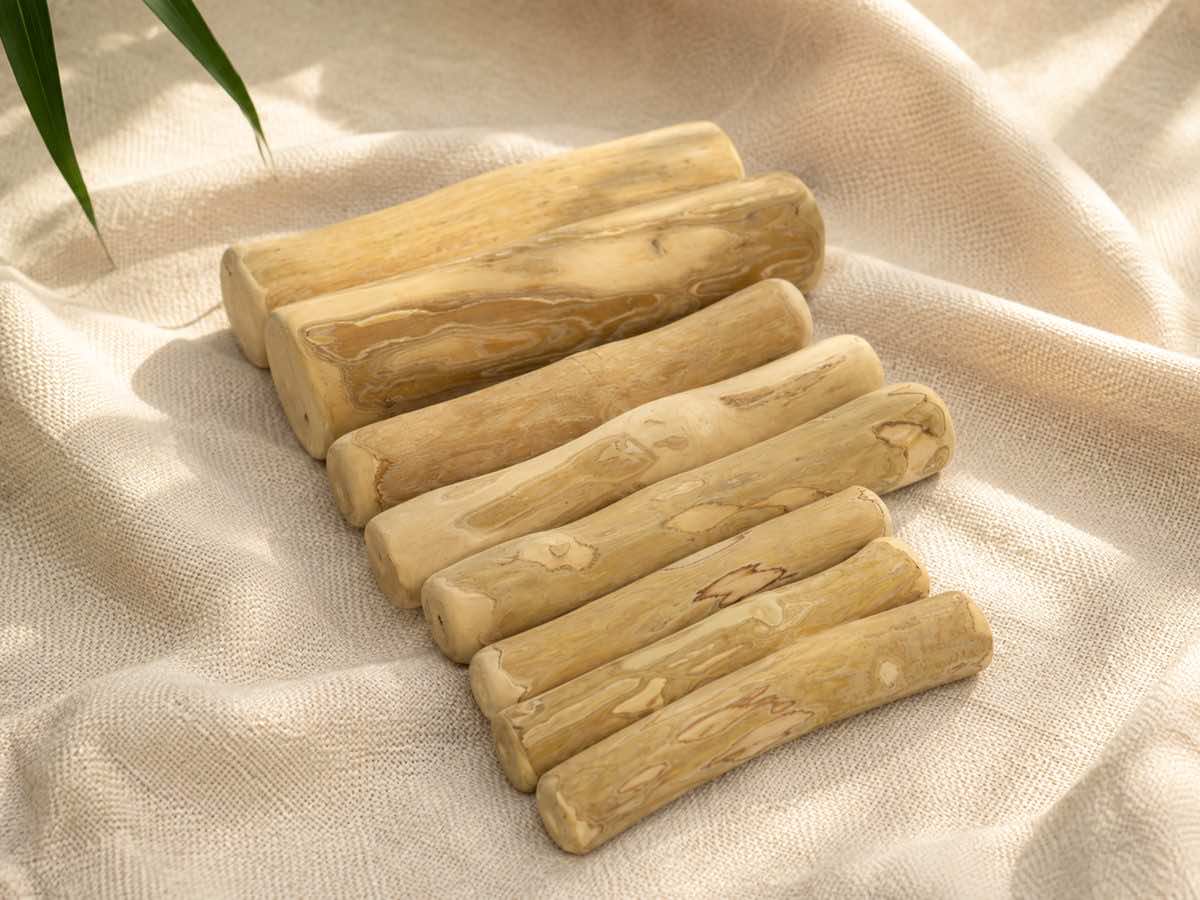
See the wood before you commit shelf space
MOQ starts at 50 pcs per product — sizes can be mixed. 3 free samples per customer. You cover the shipping cost, which can be credited against your first qualifying production order. Our sales team confirms the details.
Request samples and wholesale pricing