Customs classification and clearance
Which customs code does a coffee wood dog chew take?
Auf Deutsch: Kaffeeholz-Kausnacks im Großhandel: was ein Einkäufer vom Hersteller verlangen sollte — die deutschsprachige Übersicht für Großhändler, keine Übersetzung dieser Seite.
Search this question and you get customs databases: rows of shipment records under three different headings, with nothing explaining why. This page explains why, with the chapter notes and the published rulings, so you can take a reasoned position to your own broker instead of copying whatever the last shipment used. Then it goes past the code, because the code is rarely the thing that holds a shipment: further down there is a market-by-market breakdown of what the EU, the United States, the United Kingdom, Canada, Australia and Japan each ask for on top of it.
The short answer
Buyers most often enter coffee wood chews under heading 4421, other articles of wood. Not 2309, and not 9503. Two chapter notes and one published tariff ruling say why, and they are set out below.
Classification is the importer's responsibility, not the supplier's. WINVN INT gives you the technical description and the reasoning; the decision and the liability are yours.
Why not 2309, animal feed
This is the heading most people assume, because a dog puts the product in its mouth. Chapter 23 Note 1 sets two hurdles, and a piece of coffee wood clears neither.
The note covers products used in animal feeding, “not elsewhere specified or included, obtained by processing vegetable or animal materials to such an extent that they have lost the essential characteristics of the original material”.
- “Not elsewhere specified or included.” Heading 2309 is a residual heading. It catches what no other heading describes. A wooden article is described by heading 4421, so 2309 never gets reached.
- “Lost the essential characteristics of the original material.” A coffee wood chew is cut, dried, sanded and finished. It is still recognisably coffee wood. Nothing has been reduced, compounded or reconstituted.
The published rulings show the same line being drawn. Every UK Advance Tariff Ruling that puts a dog chew into 2309 concerns a compounded mixture of edible ingredients — a rawhide derivative bound with starch, or soft chews built from brewer's yeast, sweet potato and tapioca. Those materials genuinely have lost their original characteristics. A stick has not.
The same logic appears in United States practice from the other direction: plain rawhide is classified as an animal product, and only becomes a 2309 preparation once it is compounded with starch or rice into a mixture.
Why not 9503, toys
Shorter, because the note is explicit. Chapter 95 Note 5 states that heading 9503 “does not cover articles which, on account of their design, shape or constituent material, are identifiable as intended exclusively for animals, for example, ‘pet toys’”, and directs that they are classified in their own appropriate heading.
For a wooden article, that heading is 4421. Customs authorities apply this consistently: pet products get classified by what they are made of — textile, rubber, plastic, wood — not by the fact that an animal plays with them.
The ruling that settles it, and why it helps
In May 2024 HMRC issued Advance Tariff Ruling 600010484, valid to 30 May 2027, for a wooden dog chew: olive branches sanded to remove sharp edges and then dipped in olive oil. The ruling classified the goods under 4421 99 99 99, other articles of wood, reasoning under General Interpretative Rule 3(b) that the branch, not the oil, gives the goods their essential character.
Why that helps a coffee wood shipment even more
That product had two materials, wood and an added food oil, so the ruling had to reach for GIR 3(b) to decide which one dominated. WINVN INT's coffee wood chew has one material and nothing added — no oil, no coating, no flavouring, no binder.
With a single material there is nothing to weigh. GIR 1 alone gets you to 4421. Legally, that is a simpler and firmer position than the case that has already been ruled on.
What comes with 4421: the Deforestation Regulation
Classifying honestly has a consequence worth stating plainly, because some suppliers will not.
Annex I of Regulation (EU) 2023/1115 lists ex 4421 — other articles of wood. So a coffee wood chew entered under 4421 is in scope of EUDR. Obligations begin 30 December 2026 for large and medium operators and for downstream operators and traders of any size, and 30 June 2027 for micro and small enterprises.
The due diligence statement is filed by the operator placing the goods on the EU market, not by the supplier. What that operator will need from any Vietnamese supplier is geolocation data for the plots the wood came from.
A word about the shortcut
Heading 2309 is not in EUDR Annex I. That is the whole reason you will occasionally see a wooden chew declared as feed.
It is a bad trade. If the goods are reclassified, the importer faces a duty adjustment and the discovery that a due diligence obligation was skipped — and under Article 15(2) of the Union Customs Code the declarant, not the supplier, is answerable for the accuracy of the declaration. A code that avoids a regulation by describing the goods as something they are not is not a saving. It is a deferred problem with your name on it.
What does not come with it: no animal health certificate
Buyers ask this constantly, usually after finding a government page about export health certificates for dog chews and assuming it applies. It does not, and there is a clean legal reason.
Regulation (EU) No 142/2011, Annex I, point 17 defines the term:
| “dogchews” means products for pet animals to chew, produced from untanned hides and skins of ungulates or from other material of animal origin |
“Dogchew” there is a legal term about animal by-products, not a commercial description. Coffee wood contains no material of animal origin, so it is not a dogchew in that sense. Three things follow:
- No export health certificate for animal by-products — the UK's certificate 8325 covers Category 3 animal by-product material and does not reach wood.
- No approved animal by-product establishment under Regulation (EC) 1069/2009.
- No veterinary check at a border control post. Feed of non-animal origin only routes through a border control post if the commodity is on the increased-controls list under Regulation (EU) 2019/1793.
If a freight forwarder tells you a wooden chew needs a veterinary health certificate, that is the point to ask which regulation they are reading.
What applies whatever the code says
Customs classification and feed law are two independent systems, and getting one right does not settle the other.
Regulation (EC) 178/2002 defines feed as any substance or product intended to be used for oral feeding to animals. That definition turns on intended use, not on a customs heading. Regulation (EC) 767/2009 on the placing on the market of feed applies on that basis, and FEDIAF's labelling code addresses chews directly — treating them as complementary pet food, or as a feed material where the product is a single ingredient.
So entering under 4421 does not exempt the product from EU feed labelling. In particular, Article 13 of Regulation (EC) 767/2009 prohibits disease claims outright, whatever the customs paperwork says. That is why WINVN INT will not print a dental or health claim on packaging for any buyer — the rule attaches to the product, not to the declaration.
What your market asks for on top of the code
The heading is the same almost everywhere. Heading 4421 is part of the Harmonized System, so the first six digits are identical in every country that uses it, and the national digits after that are just statistics. What genuinely differs between markets is the paperwork each one attaches to a wooden article arriving from Vietnam, and that is where shipments actually get held.
The short version: most markets ask for nothing beyond a normal commercial entry. Two do ask for more, and they are not the two people expect.
| Market | Plant health document | Feed or veterinary gate | Where the binding answer lives |
|---|---|---|---|
| European Union | Not required for this heading | None. No animal material, so no animal by-product route and no border control post | Set out in full on our EU import guide, with the EUDR position on this page |
| United States | Not required. APHIS lists a finished wood product machined smooth on all sides as generally authorized | None from APHIS Veterinary Services, which covers animal-origin material only | APHIS ACIR. But see the Lacey Act declaration below, which is required and is frequently missed |
| United Kingdom | Not required. Commodity code 4421 sits on the uncontrolled list, not the controlled one | None. The animal by-product rules reach only material obtained from animals | Import wood, wood products or bark |
| Canada | Likely required. CFIA controls solid wood by thickness and surface, not by heading | None. The Feeds Act does not reach dog or cat food at all | CFIA AIRS, then written confirmation from the National Import Service Centre |
| Australia | Treatment to a stated specification, certified at origin | Possibly. Australia runs a separate plant-origin pet food pathway that is permit-bound | BICON. Which case applies decides whether a permit is needed |
| Japan | Worked wooden articles are on the list of plants not subject to import plant quarantine | The Pet Food Safety Act reaches things used to provide nutrition, and excludes toys | MAFF Plant Protection Station |
The two that are not routine
Canada is the one to plan for. CFIA does not ask what heading the goods take. It asks what the wood is. Its forest products directive treats wood as exempt when it has been processed in a way that significantly reduces its ability to host pests, and the examples it gives are composite and manufactured goods: plywood, fibreboard, tool handles, finished furniture, dried handicrafts with components no thicker than 1.5 cm. A solid piece of stem wood is none of those. In a notice dated 20 March 2026, CFIA set out how it treats goods with wood components arriving from outside the continental United States: entirely processed wood and pieces under 1.5 cm thick carry no additional requirement, pieces over 1.5 cm thick need a phytosanitary certificate with fumigation or heat treatment, and anything with round wood or bark needs an import permit after a risk analysis.
Read that notice honestly and you will see its stated scope is saunas, playground modules and prefabricated building kits, not dog chews. So it does not decide your entry. What it does show is the test CFIA applies to solid wood, and by that test a chew thicker than 1.5 cm, which is most sizes above the smallest, sits in the row that needs a certificate. Plan on supplying one, keep the goods free of bark and free of natural round surface, and get the answer in writing from CFIA before the container is booked rather than after it arrives.
Australia is the one nobody expects. Removing animal material removes the product from the animal biosecurity pathway, which is the answer most suppliers give and it is true as far as it goes. It is not the whole answer. Australia also runs a plant-origin pet food pathway, and on that pathway an import permit is required for all animal feed regardless of quantity. Whether the department reads a coffee wood chew as a timber article or as plant-origin pet food is the single question that decides whether your buyer needs a permit, and we are not going to guess it for you. Resolve it in BICON against your own description of the goods, or ask the department directly, before you order.
We would rather write that plainly than tell you Australia is clear and be wrong. A supplier who tells you no permit is needed is telling you something they have not checked.
The United States asks for a species. Our certificate gives a genus.
This one catches people, because it has nothing to do with plant health or with pet food, and because nothing about the goods triggers it. It is triggered by the heading itself. To be clear before anything else: the United States is a routine destination for this product, shipments have gone out under a phytosanitary certificate issued for entry to the United States, and they have cleared. The point of this section is not that something is wrong. It is that one of the filings involved is made by you rather than by us, and it asks a question the phytosanitary certificate does not answer.
The Lacey Act requires an import declaration for plants and plant products entering the United States, and it is filed by the importer of record, not by the exporter. Heading 4421 has been inside that requirement since Phase IV of the phase-in schedule, which took effect in 2010. If your entry is formal, a declaration is due, filed electronically through ACE or on PPQ Form 505.
APHIS lists what has to be on it. Alongside the ordinary entry data, the declaration carries the scientific name, genus and species, of the plants in the shipment, the country from which the plant was taken, and the quantity in metric units. Where the species used varies and the exact species is not known, the rule does not let you leave it blank or stop at the genus: the declaration must then name each species that may have been used.
Two exemptions exist and neither one helps here. The common cultivar exemption is written to cover a plant other than a tree, and the rule states plainly that trees are not common food crops. Coffee is a tree. A coffee wood chew is a plant product from a tree, so the declaration is due and it needs a species on it.
Where that collides with the paperwork
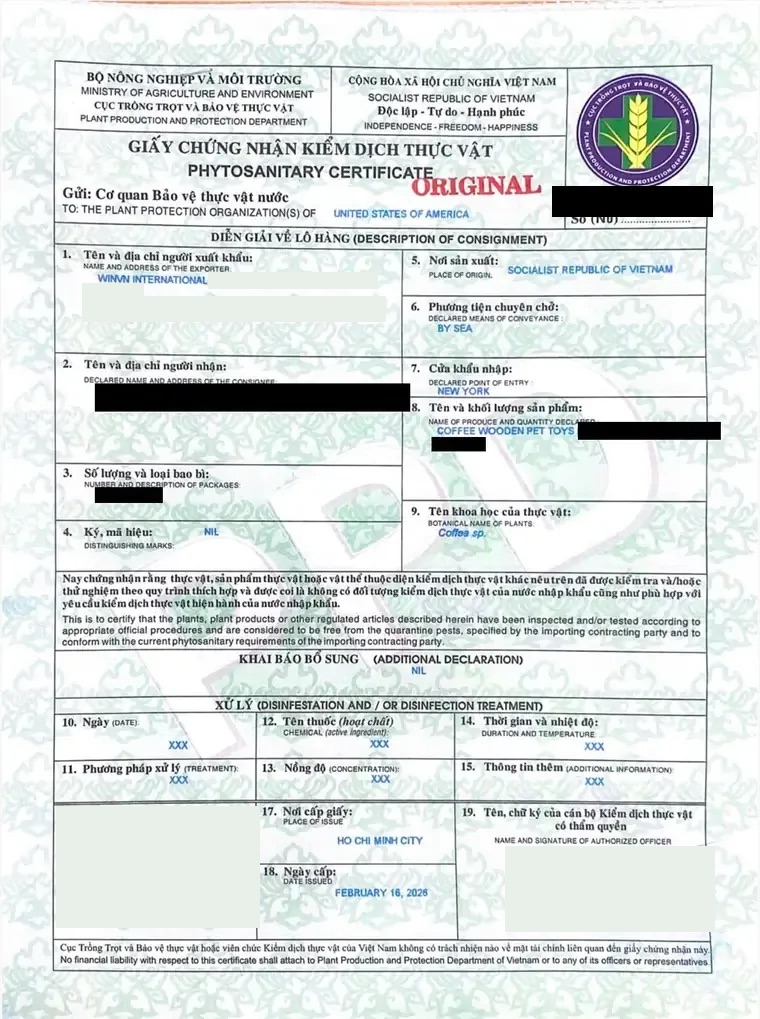
Look at the phytosanitary certificate reproduced further down this page. The botanical name on it reads Coffea spp. That is the genus with the species unstated, and on a phytosanitary certificate it is entirely normal and entirely sufficient, because plant health officers are asking a pest question, not a taxonomy question. It is not sufficient for a Lacey declaration, which is asking a different question for a different reason.
So do not build your filing out of the phytosanitary certificate. It answers the wrong question. What we can tell you is where the wood is collected, and that is documented on the provenance page: smallholder plantations in the Central Highlands provinces, which are robusta country. If your filing needs more certainty than any supplier can give, the rule's own answer for an unknown species is the one quoted above: name each species that may have been used.
What we will not do is file it for you, or tell you it has been handled. The declaring party is the importer of record, the liability is yours, and a supplier who offers to take that off your hands is offering something they cannot deliver.
Kiln dried is not the same as heat treated
These two phrases get used as if they were interchangeable. They are not, they answer different questions, and the difference is what a plant health officer in Canada or Australia will actually look for.
Kiln drying is a moisture process. The number that matters is the moisture content of the wood when it is packed, and ours is measured at the factory below 14% before packing. That is a mold and shelf-life question, and it is covered on the moisture page.
A biosecurity heat treatment is a temperature and time process. The number that matters is the temperature reached at the core of the piece and how long it was held there. Canada's forest products directive and Australia's timber pest schedule both use the same specification, and it is the same one used for wood packaging worldwide: 56 °C at the core, held for at least 30 minutes.
Those can be the same run through the same kiln. They are not the same certificate. A kiln record that shows only a moisture reading does not evidence a core temperature, and an officer looking for a temperature will not accept a moisture figure in its place. If your market needs the treatment stated, it has to be recorded as a temperature and a hold time at the time of drying. It cannot be reconstructed afterwards from a moisture log.
Fumigation is the other accepted route to the same end, and WINVN INT can supply a fumigation certificate when your market requires one, charged separately (see shipping terms and documents). Whether its dosage, exposure time and temperature match your market's timber pest schedule is a question to settle against that schedule, so ask for the certificate covering your own shipment and read the figures off it rather than assume they match.
The practical rule is short. If you are importing into Canada or Australia, say so at the quotation stage. Once the cartons are sealed and marked, the cheap moment to have done it has passed, and the expensive alternative is treatment on arrival at your cost with the container standing.
Who carries the risk
| United States | European Union | |
|---|---|---|
| Who declares | Importer of record | Declarant |
| Legal basis | 19 U.S.C. § 1484 | Union Customs Code, Article 15(2) |
| Standard | “Reasonable care” | Accuracy and completeness of the declaration |
| Who owes the duty | Importer of record | Declarant, UCC Article 77(3) |
On both sides of the Atlantic the liability sits with the buyer. A supplier who tells you which code to use is giving you an opinion it will never be asked to stand behind. WINVN INT supplies the technical description; you or your broker decide.
The duty rates this page will not give you
You will notice there are no percentages above. That is deliberate.
Duty rates change, they differ by heading, by origin, by preference agreement and by whatever trade measures are in force in the month you import. A rate copied from a supplier's website into a landed-cost model is a number nobody has verified for your shipment.
Check the current rate yourself: the EU's Access2Markets portal or TARIC for European imports, and the USITC Harmonized Tariff Schedule for the United States. For a Vietnamese origin into the EU, ask your broker specifically about preferential treatment under the EU–Vietnam agreement, which is what an EUR.1 movement certificate is for, when the goods qualify and your market requires it.
Where to read your own rate
Heading 4421 is a residual basket, so the six-digit split is stable everywhere that uses the Harmonized System: 4421.91 for articles of bamboo, 4421.99 for everything else. The digits after that are national, and so are the rates. Read them in your own country's schedule rather than in a supplier's table:
- European Union — Access2Markets or TARIC
- United States — USITC Harmonized Tariff Schedule
- United Kingdom — UK Trade Tariff
- Canada — CBSA Customs Tariff
- Australia — ABF Schedule 3
- Japan — Japan Customs tariff schedule
Ask your broker about preference separately from the base rate. Vietnam has agreements in force with the European Union and the United Kingdom, and with Canada, Australia and Japan through the CPTPP, and the preferential rate is often the one that decides whether the landed cost works. Preference is claimed with an origin document, not assumed, which is why, when the goods qualify for origin and your market requires it, WINVN INT can arrange the origin document from the first shipment, charged separately.
What the shipping documents actually declare
The argument above is a reading of the nomenclature. These three documents are from one 2026 shipment of coffee wood chews from Ho Chi Minh City to Germany, and they show the heading and the goods description that were actually used on paper. Consignee and transport details are blacked out.
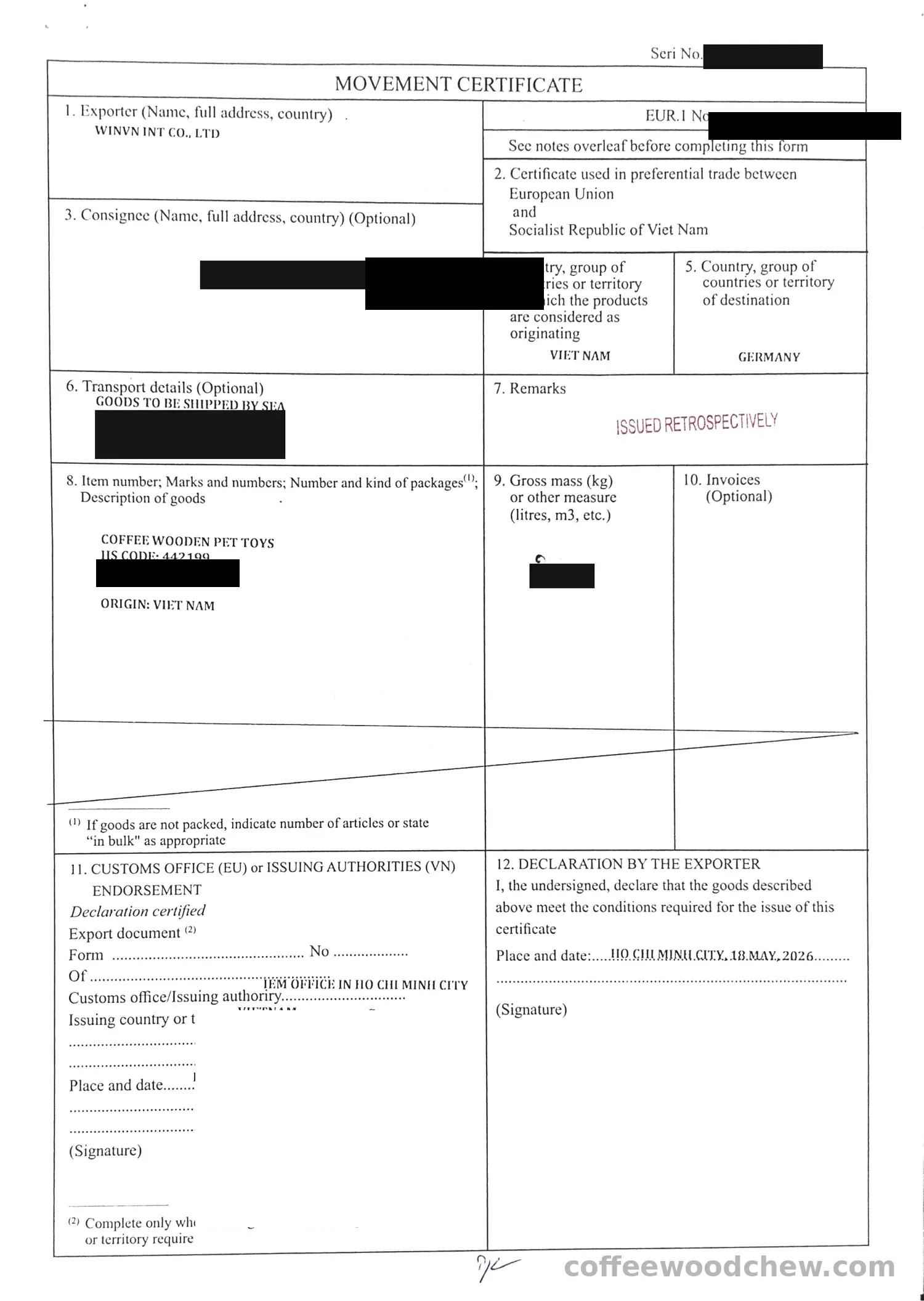
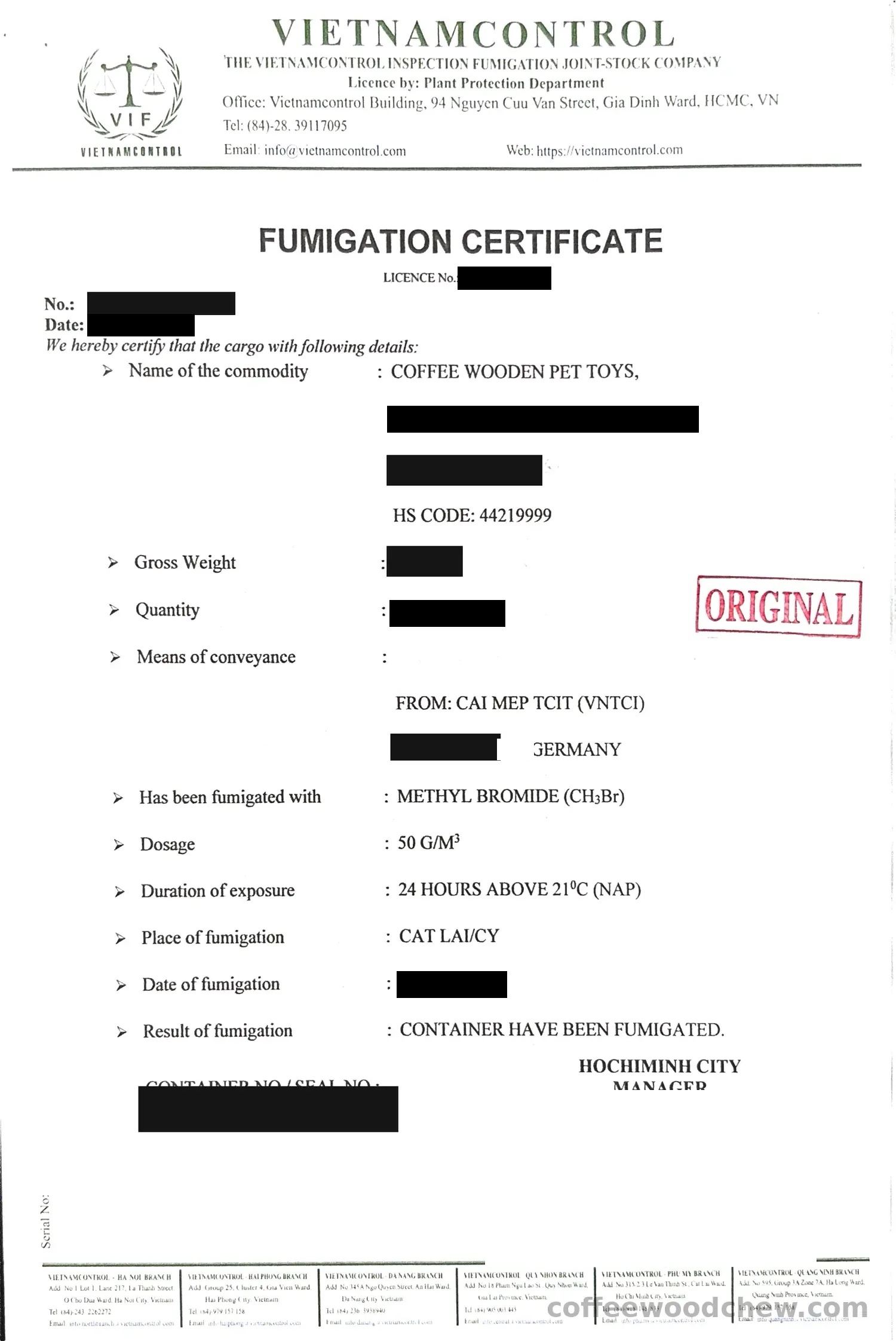
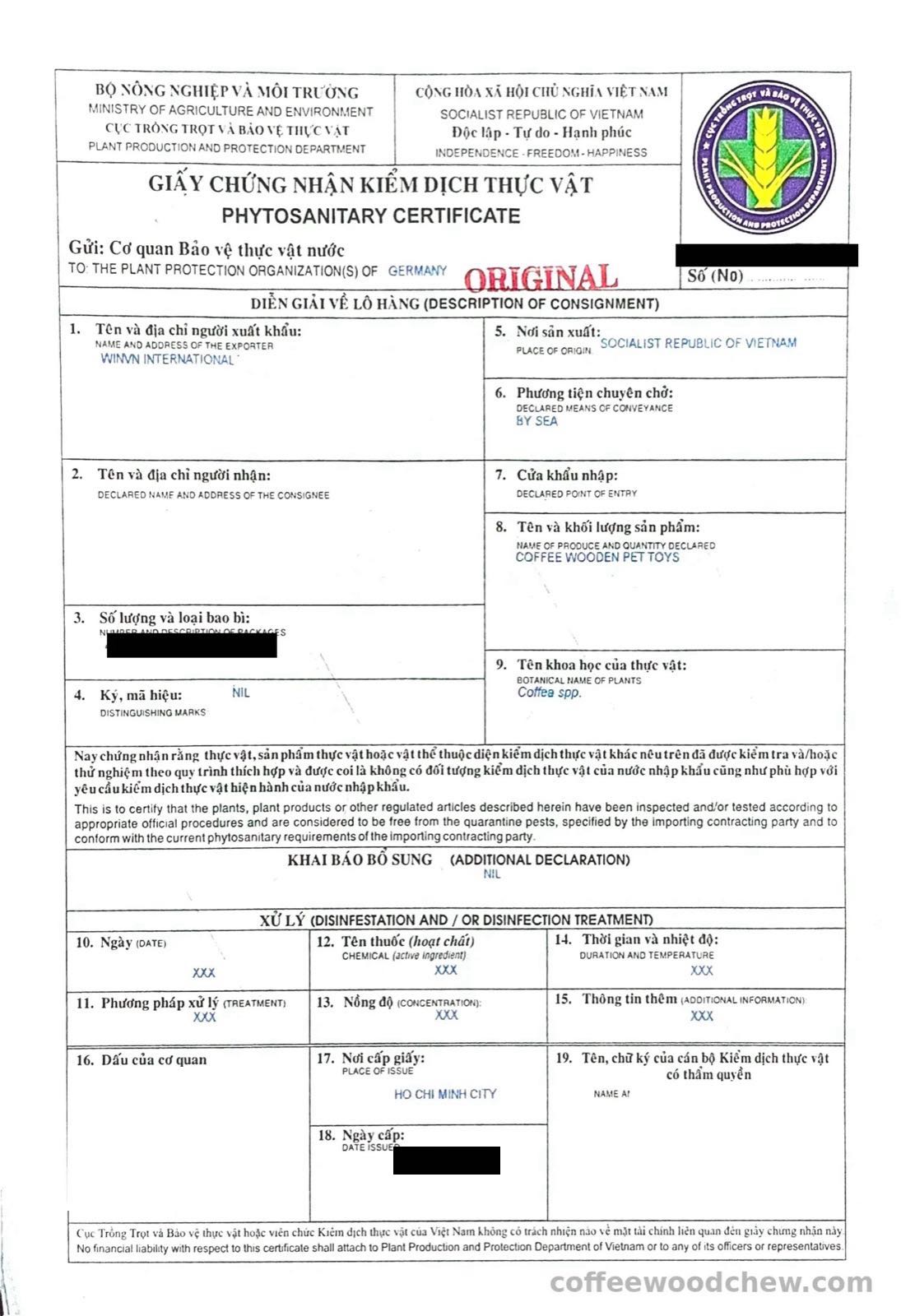
None of these three is a binding tariff ruling, and no published binding ruling exists anywhere for coffee wood dog chews. What they show is the heading under which the goods have moved in practice, on paper issued by named authorities, with numbers and dates a broker can ask to verify.
What to send your broker
If you want certainty rather than a supplier's opinion, apply for a binding ruling — a Binding Tariff Information in the EU, or a ruling from the customs authority in your market. Both are free and both bind the authority. Send them:
- Material: one plant material, wood of Coffea sp., recorded as such on the phytosanitary certificate.
- Processing: cut, dried to below 14% moisture, sanded, ends finished.
- Additives: none. No oil, coating, flavouring, binder or colouring.
- Intended use: a chew for dogs.
- Packaging: paper and card retail packaging, or bulk inside a master carton.
- Suggested heading and reasoning: 4421, per Chapter 23 Note 1 and Chapter 95 Note 5, with HMRC Advance Tariff Ruling 600010484 as a comparable decision.
WINVN INT will supply that description on letterhead for your application. Ask on the contact page, or see the full document chain in the EU import guide.
Questions buyers ask
What HS code does a coffee wood dog chew take?
Buyers most often enter it under heading 4421, other articles of wood. The reasoning is that heading 2309 requires material processed to such an extent that it has lost the essential characteristics of the original material, and a cut and dried piece of coffee wood has not. Classification is the importer's responsibility in every jurisdiction, so confirm it with your own broker or apply for a binding ruling.
Why is it not classified as animal feed under 2309?
Chapter 23 Note 1 sets two hurdles. First, heading 2309 covers products not elsewhere specified or included, and a wooden article is described by heading 4421. Second, it requires vegetable or animal material processed until it has lost the essential characteristics of the original material. A coffee wood stick is still recognisably coffee wood. Every published UK tariff ruling placing a dog chew in 2309 concerns a compounded mixture of edible ingredients, not a piece of wood.
Could it be a toy under heading 9503?
No. Chapter 95 Note 5 states that heading 9503 does not cover articles which, on account of their design, shape or constituent material, are identifiable as intended exclusively for animals, for example pet toys, and directs classification in their own appropriate heading. For a wooden article that heading is 4421.
Does a coffee wood chew need an export health certificate?
No, and there is a legal definition behind that answer. Regulation (EU) No 142/2011, Annex I, point 17, defines dogchews as products for pet animals to chew, produced from untanned hides and skins of ungulates or from other material of animal origin. Coffee wood contains no material of animal origin, so it is not a dogchew in that legal sense. The UK export health certificate 8325 covers animal by-products and does not apply, and consignments do not pass through a border control post for veterinary checks.
Does the EU Deforestation Regulation apply?
Yes, because Annex I of Regulation (EU) 2023/1115 lists ex 4421, other articles of wood. The obligations start on 30 December 2026 for large and medium operators and for downstream operators and traders of any size, and on 30 June 2027 for micro and small enterprises. The due diligence statement is filed by the operator placing the goods on the EU market. What that operator needs from the supplier is geolocation data for the plots.
Does classifying under 4421 exempt the product from EU feed law?
No. Customs classification and feed law are separate systems. Regulation (EC) 178/2002 defines feed by intended use, not by customs code, and Regulation (EC) 767/2009 applies on that basis. FEDIAF's labelling code addresses chews directly and treats them as complementary pet food, or as a feed material where the product is a single ingredient. A coffee wood chew is subject to EU feed labelling rules whichever heading it enters under.
Who is responsible if the code is wrong?
The importer. In the United States, 19 U.S.C. 1484 places the entry obligation on the importer of record and requires reasonable care. In the European Union, Article 15(2) of the Union Customs Code makes the declarant responsible for the accuracy of the declaration, and Article 77(3) makes the declarant the customs debtor. A supplier can give you a technical description and a suggested heading. It cannot carry the liability.
Do I need a phytosanitary certificate to import these into the United States?
No, on the basis of APHIS's own list of generally authorized non-propagative plant products, which treats a finished wood product machined smooth on all sides as admissible without an import permit or a phytosanitary certificate. That wording matters: the exemption rests on the article being genuinely finished. Retained bark or a rough natural surface would pull it back into the regulated category. All goods remain subject to inspection on arrival, and your buyer may still ask for a phytosanitary certificate as a contract term rather than a legal one, which we can arrange when asked, charged separately. Confirm your specific entry in the APHIS ACIR database.
Does the US Lacey Act declaration apply to a wooden dog chew?
Yes. Heading 4421 has been inside the Lacey Act declaration requirement since Phase IV of the phase-in, effective 2010, and neither the common cultivar nor the common food crop exemption rescues it, because both are written to exclude trees and coffee is a tree. The declaration needs the scientific name to genus and species, the country the plant was taken from, and the quantity in metric units. Note that our phytosanitary certificates state the botanical name as Coffea spp., the genus only, which is normal for plant health but is not what the Lacey declaration asks for. The section above explains how to close that gap.
Does the United Kingdom require a phytosanitary certificate for these?
No. Great Britain controls wood imports by a positive list of commodity codes rather than by a general rule about processing, and 4421, other manufactured articles of wood, appears on the uncontrolled list rather than the controlled one. There is also no animal by-product or veterinary route, because those rules reach only material obtained from animals and there is none in this product. The pallets are a separate matter: wood packaging remains subject to ISPM 15 regardless of what is on it.
Does Canada require a phytosanitary certificate?
Plan on yes. CFIA assesses solid wood by thickness and surface rather than by tariff heading, and its published framework for wood components arriving from outside the continental United States requires a phytosanitary certificate, with fumigation or heat treatment, for pieces over 1.5 cm thick that contain no round wood or bark. Most chew sizes above the smallest are thicker than that. Anything carrying bark or a natural round surface falls into a worse category that needs an import permit. That framework was published for saunas, playground modules and prefabricated kits rather than for chews, so it indicates CFIA's test without deciding your entry. Run the goods through AIRS and get written confirmation from the National Import Service Centre before booking.
Do I need an import permit to bring these into Australia?
We do not know, and any supplier who tells you flatly that you do not is guessing. Because the product contains no animal material it is outside the animal biosecurity pathway, which is the part most people check. But Australia runs a separate plant-origin pet food pathway on which an import permit is required for all animal feed regardless of quantity, and whether the department reads a coffee wood chew as a timber article or as pet food of plant origin is the question that decides it. Resolve it in BICON against your own goods description, or ask the department. Separately, timber pest treatment to a stated specification will apply, and offshore treatment is accepted where the provider is approved or endorsed by the exporting country's plant protection organisation.
Is a wooden chew regulated as pet food in Japan?
Probably not, on the wording of the Pet Food Safety Act, which covers things used for the purpose of providing nutrition to dogs and cats and expressly excludes toys and containers on the grounds that they do not provide nutrition. A non-digestible wooden chew provides none. The caution is that the ministry's own examples put gum-type chews inside the act, so the boundary between a chew and a toy is not settled for a wooden article, and we would get that confirmed in writing rather than assumed. On plant quarantine the position is clearer: worked wooden articles appear on the list of plants not subject to import plant quarantine.
Need the technical description for a ruling application?
WINVN INT sends the material and processing description in writing, with the certificates that support it.
Request the documents