By Mark Ton, CEO, WINVN INT CO., LTD · Last updated 29 August 2026
The short answer
A coffee wood chew shipment from Vietnam travels on a commercial invoice, a packing list and a bill of lading or air waybill. When your market requires them, a phytosanitary certificate naming the botanical genus, a fumigation certificate and a certificate of origin are added, charged separately; the certificate of origin is issued as EUR.1 under the EU–Vietnam Free Trade Agreement when the goods qualify for origin. WINVN INT adds a packing and specification sheet with carton counts.
Two things decide the rest: which commodity code your broker declares the goods under — an article of wood, or complementary pet food — and whether your business is caught by the EU Deforestation Regulation, which applies from 30 December 2026 for wood products. This guide sets out both, and names the questions worth asking before you place an order rather than after the container sails.
What this guide is and is not
WINVN INT manufactures and exports these chews. This page is written from the exporter’s side of the transaction — it is what WINVN INT knows because it prepares these documents. It is not customs advice, and it cannot be, because classification and duty depend on facts about your business that WINVN INT does not have. Every section ends with the question to put to your own customs broker.
1. The classification question comes first
Before the documents, the classification, because it changes which rules apply.
Coffee wood chews are declared into the EU by some suppliers as an article of wood, and by others as complementary pet food. Both classifications are in active use. They are different tariff lines, they carry different controls, and the difference lands on your landed cost and your compliance obligations — not on the supplier’s.
This is the single most common thing new buyers get wrong, and the correction usually arrives as a delay at the port.
| If declared as… | What follows |
|---|---|
| An article of wood | Plant health rules govern entry. Timber legality rules apply, including the EU Deforestation Regulation from 30 December 2026. No feed labelling obligations. |
| Complementary pet food | EU feed law applies on top: labelling under Regulation (EC) 767/2009, the claims restrictions in its Article 13, and possible registration of your business as a feed business operator under Regulation (EC) 183/2005. |
Ask your broker: which code do you intend to declare, and why? Then ask any supplier which code their last EU shipment actually cleared under. If the two answers differ, resolve it before the goods ship, not while they sit at a border control post.
2. The documents that travel with the goods
Commercial invoice, packing list and bill of lading or air waybill go with every shipment. The three certificates below are added when your market requires them, charged separately; the certificate of origin only when the goods qualify for origin.
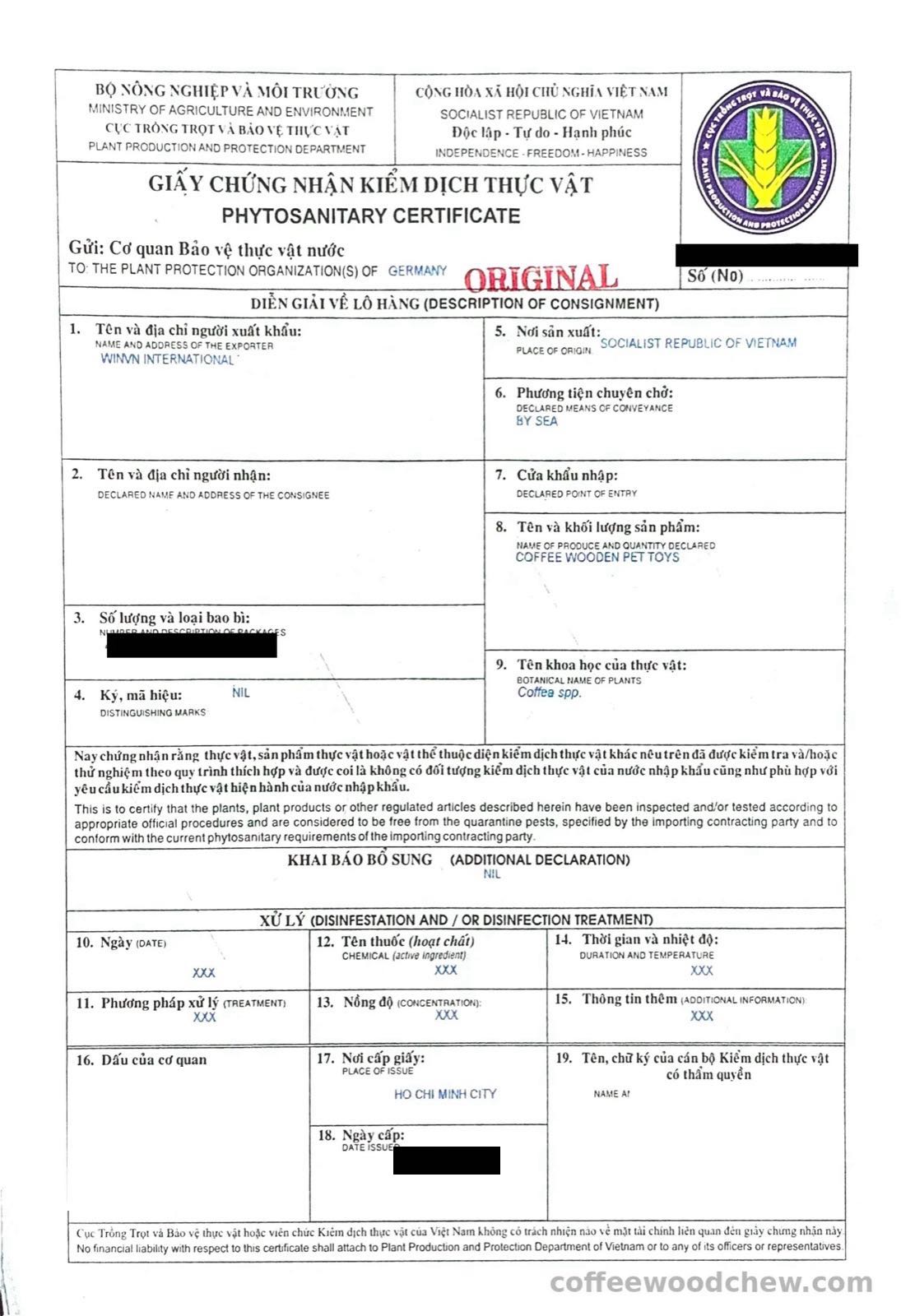
Phytosanitary certificate
Issued by the Vietnamese plant protection authority. It certifies the plant health status of the consignment and names the botanical material — for coffee wood, the genus Coffea sp. This is the document that puts coffee wood on the plant route rather than the animal by-product route, which matters if you are comparing it against rawhide or any hide-based chew: animal by-products enter the EU under a veterinary control regime with approved-establishment requirements and inspection at designated border control posts. Plant products do not.
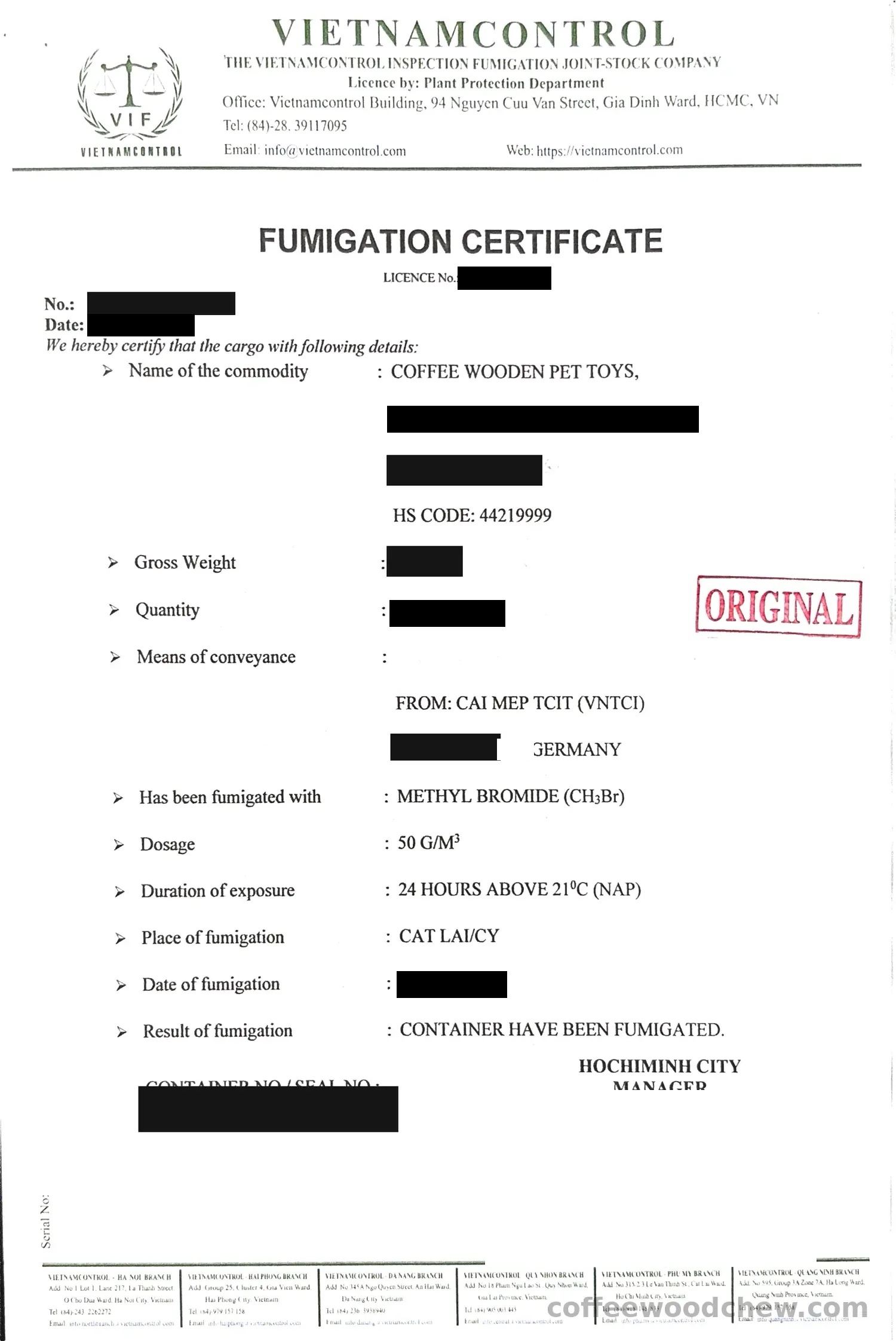
Fumigation certificate
Records the treatment applied to the consignment before shipping. Ask for it in the same request as the phytosanitary certificate; a supplier who has to go looking for one is a supplier who does not ship often.
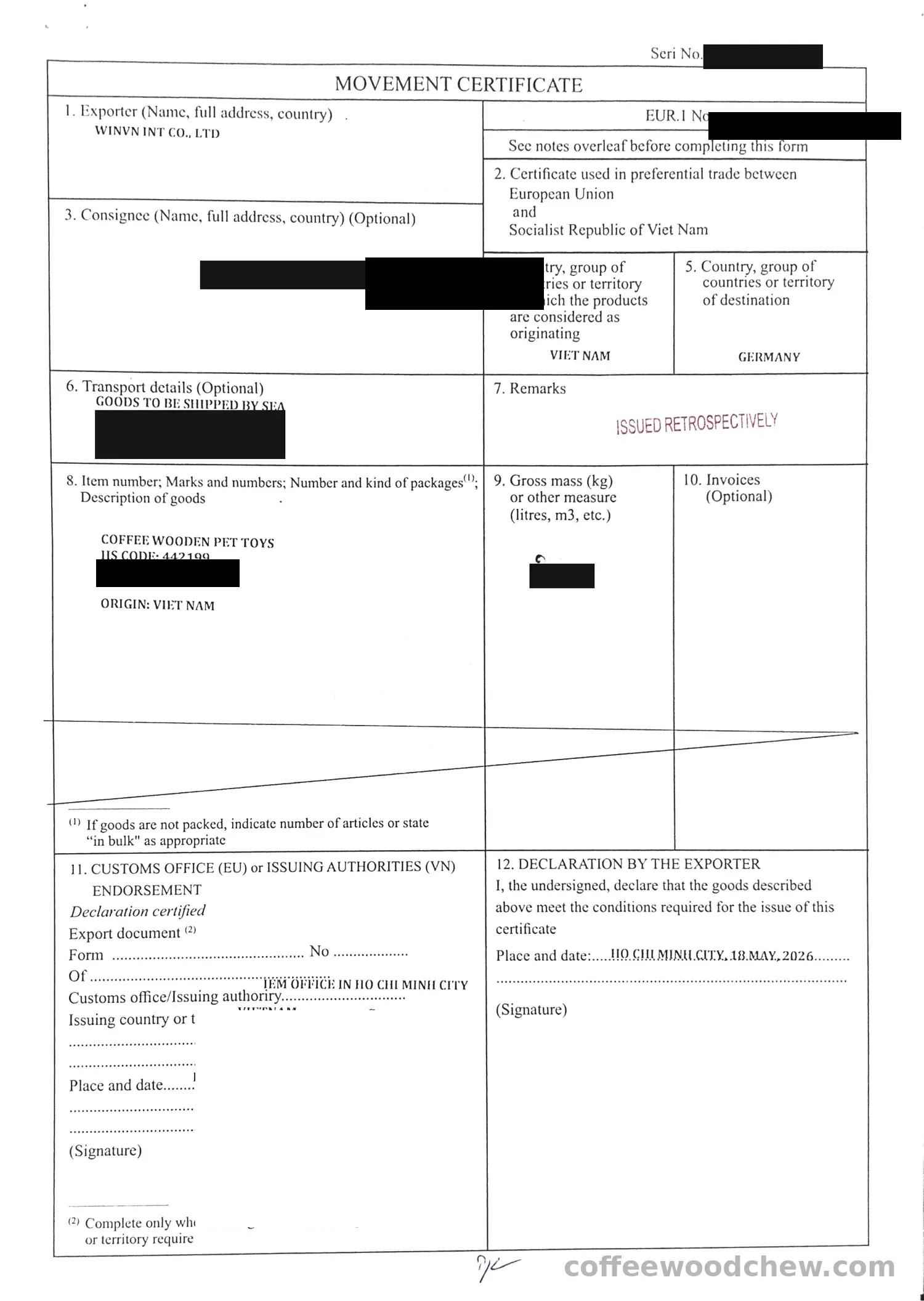
Certificate of origin — EUR.1 under the EU–Vietnam FTA
WINVN INT issues an EUR.1 movement certificate for an EU shipment when the goods qualify for origin and you need it, charged separately. An EUR.1 evidences preferential origin under the EU–Vietnam Free Trade Agreement.
What that is worth to you depends entirely on the duty rate for the code you declare under. It is possible for a line to be duty-free regardless, in which case the EUR.1 changes nothing on the invoice. WINVN INT does not publish a duty saving figure, because the figure depends on your classification and WINVN INT has not verified it. Ask your broker what the third-country rate and the preferential rate are for the code they intend to use, and you will have a real number rather than a marketing one.
Packing and specification sheet
Not a regulatory document, but the one that decides whether your warehouse receives what your purchase order said. It should state size, piece weight range, pieces per carton, carton dimensions and pallet configuration.
A practical test of any supplier, worth one email
Request all four at once, from a recent shipment, with the other buyer’s details redacted: certificate of origin, phytosanitary certificate showing the botanical name, fumigation certificate, and a packing specification. How fast they arrive tells you how often that supplier actually ships.
3. If your broker declares it as feed
Then EU feed law applies to you, and three parts of it are worth knowing before you write your product listing.
Labelling — Regulation (EC) 767/2009
This regulation governs the placing on the market and use of feed, including complementary feed for pets. It sets out what a label must carry and what it may not say.
Claims — Article 13
Two provisions do most of the work:
- Article 13(3)(a) prohibits claims that a feed will prevent, treat or cure a disease. There is no evidence threshold that unlocks this; it is a prohibition.
- Article 13(1)(b) requires that a functional claim be substantiated by scientific evidence available at the time the claim is made. Not evidence you intend to gather later.
This is why WINVN INT’s own product pages describe coffee wood as a chew rather than a dental chew, and why they carry no plaque, tartar or digestion claim. A German court has enforced this route before: OLG Schleswig, judgment of 3 August 2023, case 6 U 64/22, concerning advertising for a dog supplement, ran through § 3a of the German Unfair Competition Act — and the defendant was not relieved of the claimant’s legal costs.
The practical consequence for a buyer: a listing you write can create liability for you even where the supplier’s own material is clean. Copying marketing text from a supplier’s catalogue into an EU listing is where this usually goes wrong.
Feed hygiene — Regulation (EC) 183/2005
This regulation requires feed business operators to be registered with the competent authority in their member state. Retailing of pet food sits outside its scope; importing and placing feed on the market generally does not.
Whether your specific business must register depends on what you do with the goods after they land, and that is a question for your national competent authority rather than for a supplier in Vietnam. It is a short question to ask and an expensive one to discover late.
4. What changes on 30 December 2026
The EU Deforestation Regulation applies to wood and wood products from 30 December 2026 for large and medium operators and traders. Micro and small enterprises handling products that were already covered by the previous timber regulation — which includes wood — are caught by the same date. Other product categories for micro and small enterprises follow on 30 June 2027.
Three points a buyer needs, in order of how much they cost to get wrong.
The due diligence statement is filed by the EU operator, not by the Vietnamese supplier. The obligation sits with whoever first places the product on the EU market. If that is you, it is your filing and your liability. Downstream parties buying from a compliant EU operator retain the reference number of that first declaration rather than filing again.
What you will need back from your supplier is traceability data about where the material was grown. A supplier who has never been asked for it will not have it assembled in December.
Vietnam does not issue FLEGT licences. Vietnam has signed a Voluntary Partnership Agreement with the EU, but its licensing scheme is not operational. The European Commission states that of the fifteen countries engaged in a partnership agreement, only Indonesia has an operating licensing system. If your buying policy requires FLEGT-licensed timber, Indonesian coffee wood meets that and Vietnamese coffee wood does not — and WINVN INT would rather tell you that during qualification than after a container arrives.
Sources: European Commission, Access2Markets, on the EUDR application dates and simplifications. Read the Commission notice · European Commission, EU rules against illegal logging. Read the Commission page
5. The physical risk: moisture
Paperwork decides whether a container clears. Moisture decides whether what is inside it is sellable.
Coffee wood packed above roughly 14% moisture and then sealed in a container across the tropics can grow mold on the top layer before it reaches your warehouse. This is the single most common way a coffee wood shipment goes wrong, and it is invisible at the moment of loading.
WINVN INT measures moisture below 14% at the factory, then vacuum-packs the chews to hold that level. The settings inside the drying and quality protocol are the one thing WINVN INT does not publish.
Ask any supplier two questions: what is your moisture specification, and how do you verify it lot by lot? Every supplier says the wood is dry. Far fewer will send you a reading.
6. A realistic sequence for a starting order
| Step | What happens | Who does it |
|---|---|---|
| 1. Samples | 3 free samples per customer. You cover the shipping cost, which can be credited against your first qualifying production order. Our sales team confirms the details. Chew them past your own team before anything else. | You and your supplier |
| 2. Classification | Decide the commodity code with your broker. Confirm the duty rate with and without EUR.1. | You and your broker |
| 3. Compliance check | Ask your national competent authority whether your business must register as a feed business operator. Check whether EUDR catches you from 30 December 2026. | You |
| 4. Document dry run | Request the four documents from a recent shipment, redacted. Hand them to your broker before you order. | You and your supplier |
| 5. Starting order | 50 pcs per product, sizes can be mixed; the same MOQ with your own printed label. | You |
7. What WINVN INT will not tell you
Three things a buyer might reasonably expect from this page that are not on it, and why.
- A duty rate. It depends on your classification, and WINVN INT has not verified the third-country rate for either candidate code. A number without a source behind it is a number invented for marketing.
- A commodity code recommendation. Same reason, with a sharper edge: getting this wrong is your exposure at the border, not WINVN INT’s.
- A caffeine content figure. Laboratory results for coffee trunk wood do not exist for WINVN INT’s material yet. Published research in the journal Planta reports that caffeine in the coffee plant concentrates in leaf, fruit and seed rather than in mature woody trunk tissue. Until a result exists with a laboratory name and a report number behind it, WINVN INT will not put a figure on this page.
Pass these three instructions on with every hard chew you sell
- Match the size to the dog’s body weight.
- Keep the dog supervised while chewing.
- Take the piece away once it is worn small enough to swallow, or once an edge has broken off.
These apply to any hard chew of any material. A shop that says them out loud takes fewer returns than a shop that prints them on the back of the pack.
The European pet food federation FEDIAF gives the first two of those as general guidance for any chew, and notes that there is currently no specific legal standard for hardness in dog chews. FEDIAF fact sheet
Questions buyers ask
What documents does a coffee wood dog chew shipment from Vietnam come with?
Packing list, commercial invoice and bill of lading or air waybill for every shipment, plus a phytosanitary certificate naming the botanical genus Coffea sp., a fumigation certificate or a certificate of origin when your market requires them — the certificate of origin issued as EUR.1 under the EU–Vietnam Free Trade Agreement for EU buyers when the goods qualify for origin. WINVN INT adds a packing and specification sheet with carton counts and pallet configuration. Samples of the three certificates and the packing sheet can be sent from a recent shipment, with the other buyer's details redacted.
Are coffee wood chews classified as pet food or as an article of wood in the EU?
Both classifications are in active use by different suppliers, and they are different tariff lines with different obligations. Declared as an article of wood, plant health and timber legality rules govern. Declared as complementary pet food, EU feed law applies on top — labelling under Regulation (EC) 767/2009, the claims restrictions in Article 13, and possible registration of your business under Regulation (EC) 183/2005. Decide the code with your own broker before ordering, and ask any supplier which code their last EU shipment cleared under.
When does the EU Deforestation Regulation apply to wood products?
From 30 December 2026 for large and medium operators and traders. Micro and small enterprises handling products already covered by the previous EU timber regulation, which includes wood, are caught by the same date; other categories follow on 30 June 2027. The due diligence statement is filed by the operator who first places the product on the EU market — normally the importer, not the supplier.
Does the supplier file the EUDR due diligence statement?
No. The obligation sits with the operator who first places the product on the EU market, which is normally the EU importer. What the importer needs back from the supplier is traceability data about where the material was grown. Ask for it during supplier qualification rather than in December, because a supplier who has never been asked will not have it assembled.
Is Vietnamese coffee wood FLEGT-licensed?
No. Vietnam has signed a Voluntary Partnership Agreement with the EU but its licensing scheme is not operational. The European Commission states that of the fifteen countries engaged in a partnership agreement, only Indonesia has an operating licensing system. If your buying policy requires FLEGT-licensed timber, source from Indonesia.
What is the duty rate on coffee wood dog chews into the EU?
WINVN INT does not publish one, because it depends on the commodity code your broker declares and WINVN INT has not verified the third-country rate for either candidate code. WINVN INT issues an EUR.1 movement certificate under the EU–Vietnam Free Trade Agreement when the goods qualify for origin and your market requires it; ask your broker what the rate is with and without it for the code they intend to use.
What is the biggest practical risk in a coffee wood shipment?
Moisture. Wood packed above roughly 14% and sealed in a container across the tropics can grow mold on the top layer before it reaches your warehouse, and it is invisible at loading. WINVN INT measures moisture below 14% at the factory, then vacuum-packs the chews to hold that level. Ask any supplier for their specification and how they verify it lot by lot.
What is the minimum order?
50 pcs per product — sizes can be mixed, enough to find out whether the product moves on your shelf. Products with your own printed label use the same MOQ. 3 free samples per customer. You cover the shipping cost, which can be credited against your first qualifying production order. Our sales team confirms the details.
See the wood before you commit shelf space
MOQ starts at 50 pcs per product — sizes can be mixed. 3 free samples per customer. You cover the shipping cost, which can be credited against your first qualifying production order. Our sales team confirms the details.
Request samples and wholesale pricing