Compliance
EUDR and coffee wood dog chews: who files, and what your supplier has to hand you
Auf Deutsch: Kaffeeholz-Kausnacks im Großhandel: was ein Einkäufer vom Hersteller verlangen sollte — die deutschsprachige Übersicht für Großhändler, keine Übersetzung dieser Seite.
From 30 December 2026 a wooden dog chew cannot be placed on the EU market unless someone has filed a due diligence statement for it. Most of the questions WINVN INT receives about this get the direction of the obligation wrong: buyers ask the supplier to become compliant, when the filing, the liability and the enforcement all sit on the EU side of the transaction. What the supplier owes is data. This page sets out which data, and who has to produce it.
The short answer
The EU importer files the due diligence statement. WINVN INT does not, cannot, and has no account in the system to file with.
The one date to plan around is 30 December 2026 — and the practical deadline is earlier than that, because a supplier who has never been asked for plot data will not have it assembled in December.
1. The obligation sits with the operator, not the exporter
Regulation (EU) 2023/1115, as amended by Regulation (EU) 2025/2650, puts the duty on the operator: the party that first places a product on the EU market. For a container shipped from Cat Lai to Rotterdam, that is the EU importer. The amended text states that the obligation and the responsibility to submit the due diligence statement lie exclusively with those first-placing operators.
Two consequences follow, and both are commercially useful to know before you negotiate:
- A Vietnamese supplier cannot be EUDR-compliant on your behalf. There is no supplier registration, no supplier statement and no supplier certificate in the regulation. Anyone offering you one is describing something the regulation does not contain.
- Downstream buyers no longer file their own statement. The 2025 amendment removed that duplication. If you buy from an EU operator who has already filed, you collect and retain the reference number of that first declaration instead of repeating the exercise.
Source for the mechanism and the dates: the European Commission's Access2Markets notice on the postponement and simplification of the EUDR, and the Council of the EU's press release of 18 December 2025 confirming the revision. Links at the foot of this page. This page is a supplier's description of what buyers ask for; it is not legal advice, and your own customs counsel remains the party who signs off on your filing.
2. The dates, and the one that is not a date
| Date | Who it applies to |
|---|---|
| 30 Dec 2026 | Large and medium operators. Downstream operators and traders of any size. Micro and small enterprises handling products already covered by the earlier EU Timber Regulation — which includes wood. |
| 30 Jun 2027 | Natural persons and micro enterprises, for the remaining product categories. |
| 31 Dec 2020 | Not an application date. The deforestation cut-off: the land has to have been agricultural or otherwise non-forest before this date for the material to qualify. |
Because a coffee wood chew is a wood article, the micro-and-small carve-out to June 2027 does not help a small importer of these goods. Wood was inside the old timber regulation, so wood moves on the December 2026 date regardless of company size.
The cut-off date is where coffee wood is unusually well placed. A coffee plantation is farmland that was farmland decades before 2020, and the paperwork to prove it exists for ordinary agricultural reasons rather than for the EUDR.
3. What you have to collect from the supply side
A due diligence statement asks for information about the goods and about where the material was grown. Some of it you already hold from your own commercial documents; some of it only the supplier can produce. It is worth separating the two, because it tells you exactly what to put on a qualification questionnaire.
| Data point | Where it comes from |
|---|---|
| HS code | Your customs entry. WINVN INT ships under heading 4421, the residual heading for other articles of wood. |
| Description and quantity | Commercial invoice and packing list. |
| Country of production | Certificate of origin. Shown further down this page. |
| Scientific name of the species | Phytosanitary certificate, which names the botanical genus. Shown further down this page. |
| Plot geolocation | Supplier only. Latitude and longitude to six decimal places; a plot of four hectares or less needs one point rather than a polygon. |
| Production period | Supplier only. For coffee wood this is the harvest registration date, not a growing season. |
| Evidence the land was not forest after 31 Dec 2020 | Supplier only. Planting year and land-use documentation. |
The three rows marked supplier only are the reason to start a qualification conversation now rather than in the last quarter of 2026. Nothing on the top four rows is difficult; the bottom three require a supplier who has already been back down the chain to the grower.
4. Two of the data points are already on documents you may receive
Before asking for anything new, it is worth noticing how much of a due diligence statement is answered by documents that travel with a shipment when your market requires them. Both of the certificates below are issued by third parties, not by WINVN INT, and both are checkable against the issuing authority.
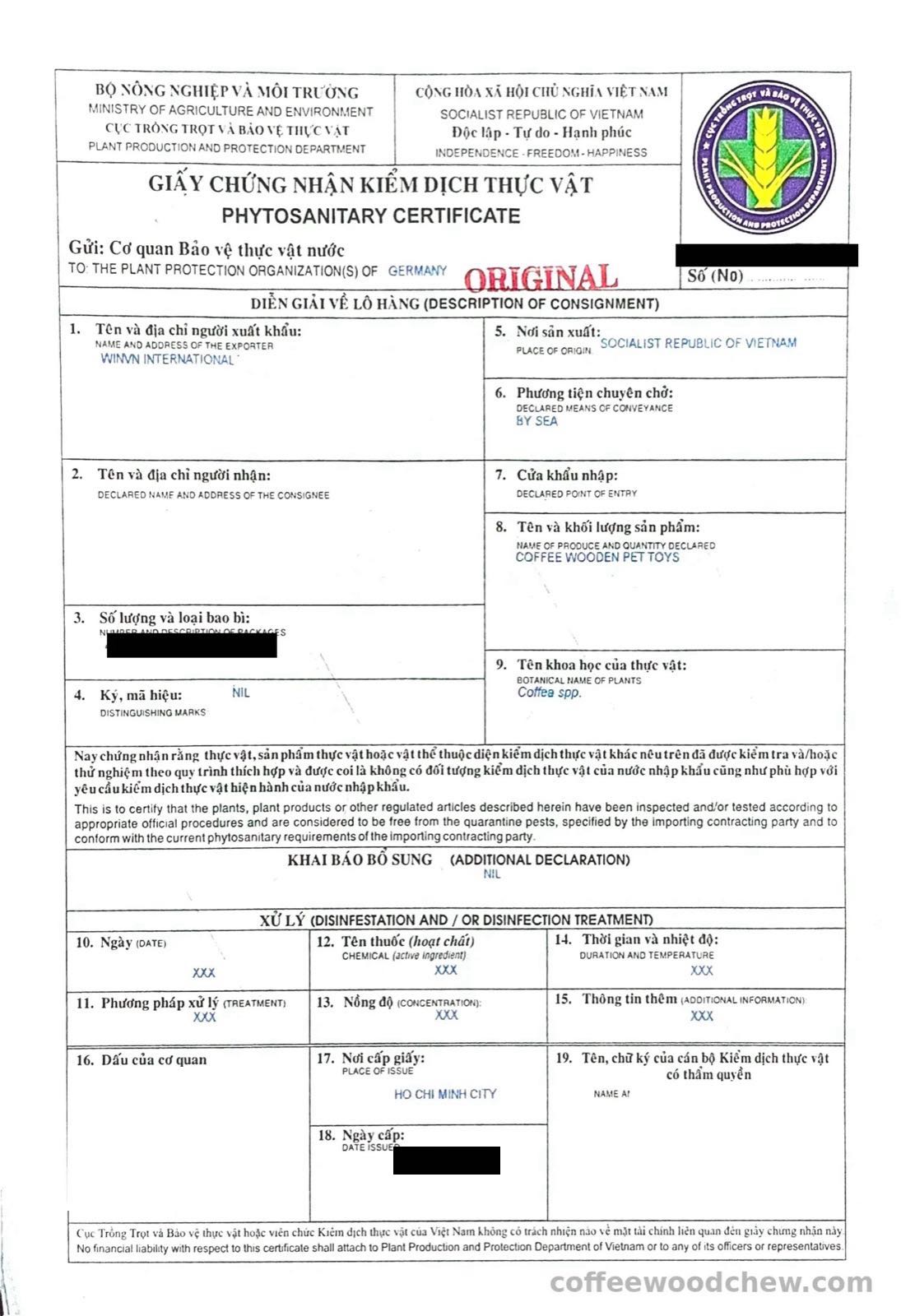
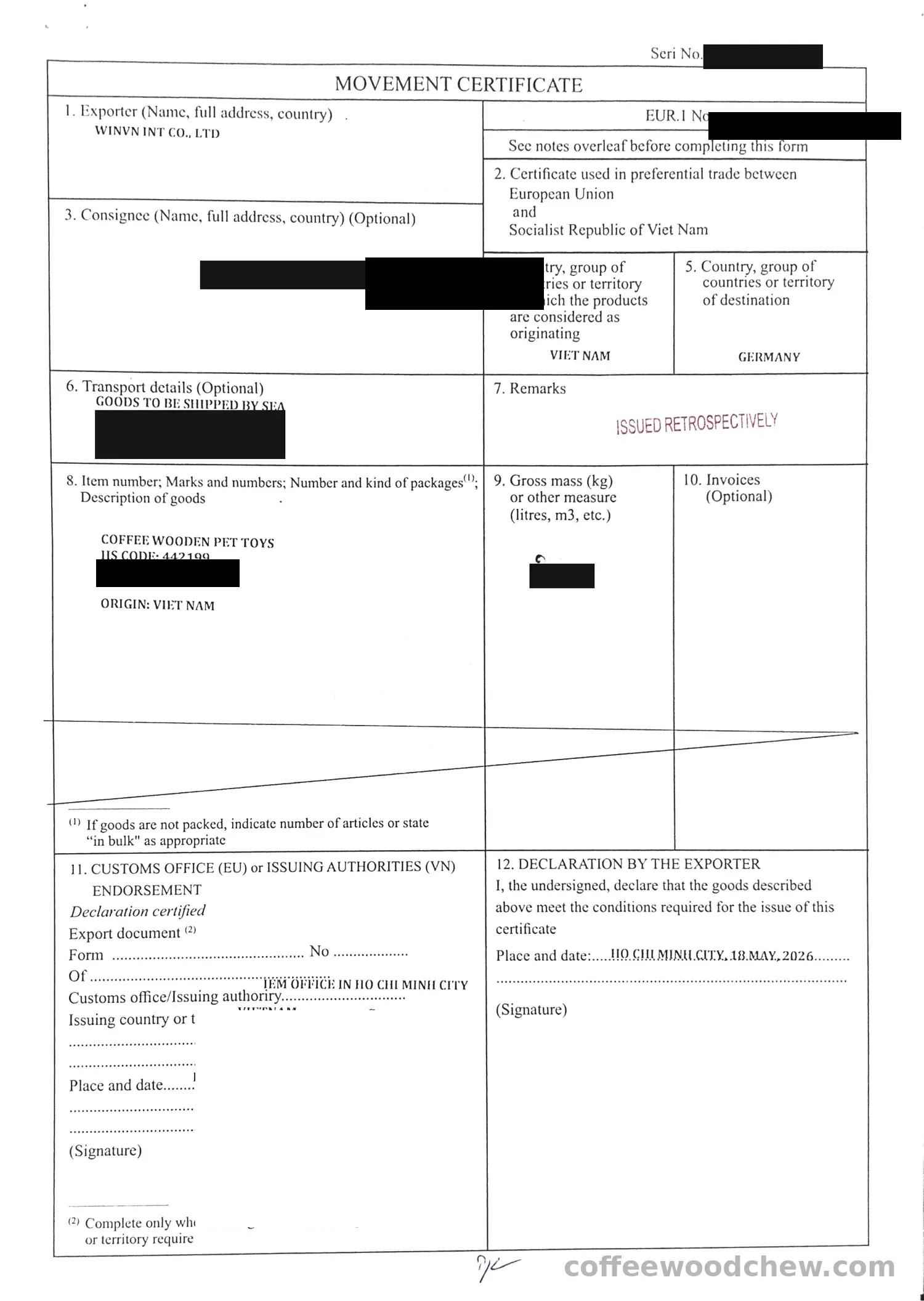
Both images are redacted in the same way as elsewhere on this site: consignee details, container and seal numbers, and values are blacked out. The issuing authority and the commodity description are left readable, because those are the fields a buyer verifies.
5. The part that does not favour Vietnam
Vietnam has signed a Voluntary Partnership Agreement with the EU, but the licensing scheme under it is not operational. The European Commission states that of the fifteen countries engaged in a partnership agreement, only Indonesia has an operating licensing system.
The practical effect: a FLEGT licence discharges part of an operator's legality assessment automatically. Vietnamese material carries no such licence, so the operator does the legality work itself using the documents described above. If a buying policy requires FLEGT-licensed timber as a hard condition, Indonesian coffee wood meets it and Vietnamese coffee wood does not.
WINVN INT would rather a buyer learn this during qualification than after a container has arrived. The same comparison, including where Indonesia genuinely wins, is set out on the country comparison page.
6. What this page deliberately does not claim
- WINVN INT is not an EUDR operator and does not file due diligence statements. There is no WINVN INT reference number to quote.
- WINVN INT issues no deforestation-free certificate, because the regulation creates no such supplier document.
- This page makes no environmental marketing claim at all. WINVN INT does not tell buyers the product breaks down in soil, publishes no carbon figure, and does not use the regulated green adjectives that Directive (EU) 2024/825 begins policing on 27 September 2026. If your own packaging needs a claim of that kind, the test data behind it has to be yours.
This list exists because the most common failure mode in EUDR conversations is a supplier who says yes to everything during qualification and produces nothing in December. A supplier who tells you the edges of what it holds is easier to plan around than one who does not.
7. A realistic sequence before December 2026
- Now. Ask every wood supplier for a sample plot dossier and the geolocation format they can deliver. The answer, or the absence of one, tells you more than a questionnaire will.
- From December 2026. File as the operator, keep the reference number, and pass it downstream instead of asking your customers to file again.
Questions buyers ask
Does the EU Deforestation Regulation apply to dog chews made from coffee wood?
Yes. The EUDR covers wood and products made from wood, and a coffee wood dog chew is a wood article. WINVN INT ships these under HS heading 4421, the residual heading for other articles of wood, which sits inside the regulation's wood annex. The chew is not exempt because it is sold as a pet product, and it is not exempt because the tree was an agricultural crop rather than forest timber.
Who files the EUDR due diligence statement for a container of coffee wood dog chews?
The operator who first places the goods on the EU market, which for an import from Vietnam is the EU importer. Regulation (EU) 2025/2650 states that the obligation and responsibility to submit the due diligence statement lies exclusively with those operators. WINVN INT does not file, holds no TRACES account and cannot file on a buyer's behalf. Operators and traders further down the chain no longer submit their own statement; they collect and keep the reference number of the first one.
When does the EUDR start applying?
30 December 2026 for large and medium operators, for downstream operators and traders of any size, and for micro and small enterprises handling products that the earlier EU Timber Regulation already covered, which includes wood. 30 June 2027 for natural persons and micro enterprises handling the remaining product categories. The deforestation cut-off date is unchanged at 31 December 2020: the land has to have been agricultural land before that date.
What geolocation data does an EU importer need from a Vietnamese supplier?
Latitude and longitude to six decimal places for the plots where the material was grown, plus the production period. A plot of four hectares or less can be described by a single point rather than a boundary polygon.
Is Vietnamese coffee wood FLEGT-licensed?
No. Vietnam has signed a Voluntary Partnership Agreement with the EU but its licensing scheme is not operational, and the European Commission states that of the fifteen countries in a partnership agreement only Indonesia has an operating licensing system. If a buying policy requires FLEGT-licensed timber, Indonesian coffee wood meets that test and Vietnamese coffee wood does not. WINVN INT would rather say this during qualification than after a container arrives.
Can WINVN INT issue a deforestation-free certificate?
No, and no supplier can. The EUDR creates no supplier certificate. What exists is the operator's own due diligence statement, filed by the importer under the importer's liability.
Sources: European Commission, Access2Markets — Delay until December 2026 and other developments in the implementation of the EUDR. Council of the EU — Deforestation: Council signs off targeted revision. European Parliament — Parliament adopts changes to postpone and simplify measures.