By Mark Ton, CEO, WINVN INT CO., LTD · Last updated 29 August 2026
A nylon or thermoplastic chew is a manufactured polymer article: pellets are melted, molded to a fixed shape, and often compounded with flavour and colour additives. A coffee wood chew is one plant material, cut from the trunk of a coffee tree that has finished producing fruit.
For a retail buyer the useful comparison is not which is “better”. It is which claims each supplier can put a document behind. This page sets out what is documentable on both sides — and names the two things WINVN INT cannot yet document about its own product.
What each material is
Nylon and thermoplastic chews. These are molded from synthetic polymer — most commonly a polyamide (nylon) or a thermoplastic elastomer. The material is produced industrially from petroleum-derived feedstock, then melted and injection-molded. Because the shape is molded rather than cut, every unit is dimensionally identical, and the manufacturer can specify hardness precisely. Many are compounded with flavourings so the dog stays interested in a material that has no nutritional content.
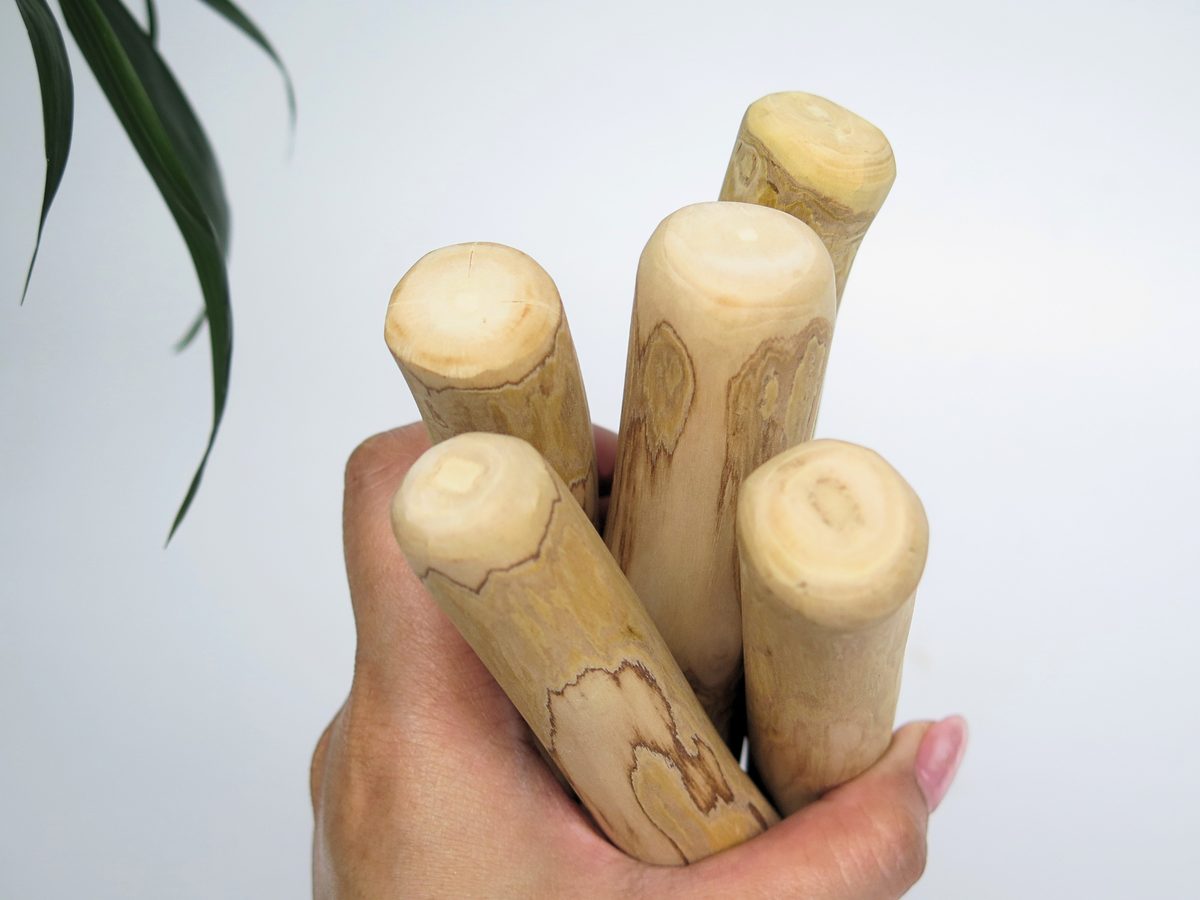
Coffee wood. This is the trunk of a Coffea sp. tree, cut when the plot is replanted. WINVN INT harvests from Vietnamese highland plots at twenty years and older. The wood is dried under controlled conditions to below 14% moisture and finished mechanically. No bleach, no degreasing agent, no flavouring, no binder, no colourant. Sizes are natural and vary slightly piece to piece.
| Factor | Coffee wood | Nylon / thermoplastic |
|---|---|---|
| Number of ingredients | One — coffee trunk wood | Polymer plus additives; ask for the full declaration |
| Additives, flavouring, colourant | None | Common — check the specification |
| Dimensional consistency | Sizes are natural and vary slightly piece to piece. | Identical — molded to a fixed cavity |
| Hardness specified by the maker | Not specified — natural material | Yes, usually to a stated shore value |
| EU regulatory category | Complementary feed / article of wood — confirm the code with your broker | Usually a pet accessory rather than a feed |
| Shipping documents from Vietnam | Invoice, packing list, B/L or AWB for every shipment; phytosanitary, fumigation or certificate of origin (EUR.1 for the EU) when the market requires them | Depends on the country of manufacture |
| Moisture | Measured below 14% at the factory before packing | Not applicable |
Where nylon and plastic genuinely win
A comparison that gives one side every row is not a comparison, so here is the honest list.
- Consistency. A molded chew is identical unit to unit, batch to batch, year to year. Coffee wood is a natural material and it varies. A buyer who has built a listing around exact photographed dimensions will find a molded product easier to manage.
- Specified hardness. A synthetic manufacturer can state a hardness value and hold it. Nobody can state a hardness value for a natural trunk and hold it across every plot and every season.
- Shelf life and storage. Polymer does not care about humidity. Wood does: coffee wood needs dry, ventilated storage, and a container that ships wet is a container that can grow mold.
- Price per unit at volume. Injection molding at scale is cheap. Cutting, drying and grading a natural material is not.
- Reorder predictability. A molded line runs to a schedule. Coffee wood arrives plot by plot, as farmers replant.
Where coffee wood is the stronger case
The ingredient list is one line long, and it can be checked. A phytosanitary certificate names the botanical genus of the material in the container. There is no formulation to disclose, because there is no formulation. For a retailer whose customers ask what is in a product, that is a short and verifiable answer.
The material was already going to be cut down. Coffee trunks come out of the ground when a plot is replanted, whether or not anyone buys them. In the Vietnamese highlands that wood has conventionally been sold as firewood or burned on the plot. Buying it puts cash into a smallholder’s hands during the replanting season, which is the point in the year when money is tightest. That is a description of where the material comes from, not an environmental claim — see the note below on why the difference matters.
It suits shops that have already made a synthetic-free decision. A number of European pet retailers have set buying policies that exclude synthetic polymer chews. For those accounts the material question is settled before the price question, and coffee wood is on the list where a molded chew is not.
What WINVN INT will not claim, and why
No degradation or compostability claim. WINVN INT holds no test data on how coffee wood breaks down under any standard, and will not publish a rate, a timescale or a certification mark it does not have.
No carbon figure. There is no life-cycle assessment for this product. A number without an assessment behind it is a number invented for marketing.
No caffeine-free claim. Laboratory results for caffeine content in coffee trunk wood do not yet exist for WINVN INT’s material. Published research in the journal Planta reports that caffeine in the coffee plant concentrates in leaf, fruit and seed rather than in mature woody trunk tissue. Until results are in hand, the honest answer is that the figure is not confirmed.
From 27 September 2026 the German implementation of Directive (EU) 2024/825 bans generic environmental wording in advertising unless it is backed by a recognised label or substantiated on the spot. WINVN INT would rather write this section now than rewrite the whole site later.
Both are hard chews, and hardness is the thing to get right
This is the point where the two materials stop being different. Coffee wood is hard. Molded nylon is hard. Every hard chew, of any material, has to be matched to the dog and taken away at the right time. A retailer who sells hardness as a feature and stops there is setting up a return.
The same three instructions apply to both
- Match the size to the dog’s body weight.
- Keep the dog supervised while chewing.
- Take the piece away once it is worn small enough to swallow, or once an edge has broken off.
The European pet food federation FEDIAF gives the first two of those as general guidance for any chew, and notes that there is currently no specific legal standard for hardness in dog chews. FEDIAF fact sheet
What to ask before you decide
- Ask a synthetic supplier for the full material declaration, including additives, flavourings and colourants, not just the polymer name.
- Ask a wood supplier for the moisture specification and how it is verified per lot. Every supplier says they dry their wood. Far fewer send a reading.
- Ask both for the commodity code their last shipment into your market cleared under, then check it with your own broker. Feed and accessory lines carry different rates and different controls.
- Ask both what happened the last time a customer reported a problem, and ask for the customer’s side of it. That answer tells you more than any specification sheet.
The settings inside the drying and quality protocol are the one thing WINVN INT does not publish. What is published is the result: moisture measured below 14% at the factory before packing.
The two materials do not land in the same chapter of the tariff
That third question is the one buyers skip, and it is the one that changes the landed cost. Two published HMRC advance tariff rulings show how far apart the two materials sit.
- A thermoplastic rubber dog chew was classified under 3926 90 97 90, articles of plastics, the ruling reasoning under General Interpretative Rule 3(b) that the thermoplastic rubber gives the goods their essential character. Ruling 600007004, issued 19 May 2023 and expired 18 May 2026 — a published reference now, not a live ruling.
- A wooden chew stick, olive branches sanded and dipped in olive oil, was classified under 4421 99 99 99, other articles of wood, the ruling reasoning that the branch rather than the oil gives the goods their essential character. Ruling 600010484, valid to 30 May 2027.
Chapter 39 and Chapter 44 carry different duty rates and different controls, and wood brings the EU Deforestation Regulation with it while plastic does not. Neither ruling is about coffee wood, a UK ruling binds only the holder and only in the United Kingdom, and classification remains the importer’s responsibility everywhere. They are worth reading anyway, because they show the reasoning customs actually applies to a chew: identify the material that gives the article its character, then classify to that material.
Questions buyers ask
Is coffee wood better for the environment than a plastic chew?
WINVN INT will not make that claim, because it holds no life-cycle assessment and no degradation testing for coffee wood. What can be stated as fact: a coffee wood chew is one plant material with nothing added, cut from trunks that come out of the ground when a plot is replanted; a nylon or thermoplastic chew is a molded polymer article produced from petroleum-derived feedstock, usually with additives. Any comparison beyond that description would be a claim without a document behind it.
Which lasts longer, coffee wood or nylon?
It depends on the dog, and both are consumables. A molded nylon chew is abraded down over time; a coffee wood stick is abraded down and shrinks. Neither can be quoted in hours honestly. The practical difference for a retailer is that both must be removed once worn small enough to swallow.
Why can a nylon supplier state a hardness value and WINVN INT cannot?
Because a molded polymer is made to a specification and a tree is not. Hardness in coffee wood varies with the age of the trunk and the part of it a piece is cut from. WINVN INT specifies what it can hold — moisture below 14% measured per batch — and does not publish a hardness figure it could not reproduce.
Do coffee wood chews contain any additives or flavouring?
No. There is no flavouring, colourant, binder, bleach or degreasing agent. The material is coffee trunk wood, dried and finished mechanically. That is the entire ingredient list, and a phytosanitary certificate, when one accompanies a shipment, names the botanical genus of the material in it.
Can WINVN INT supply a German-language version of this comparison?
Yes. This comparison is written to be translatable into German without alteration, because it contains no health claims and no generic environmental wording. Contact sale@winvnint.com for the German text.
What is the minimum order?
50 pcs per product — sizes can be mixed. Products with your own printed label use the same MOQ.
See the wood before you commit shelf space
MOQ starts at 50 pcs per product — sizes can be mixed. 3 free samples per customer. You cover the shipping cost, which can be credited against your first qualifying production order. Our sales team confirms the details.
Request samples and wholesale pricing